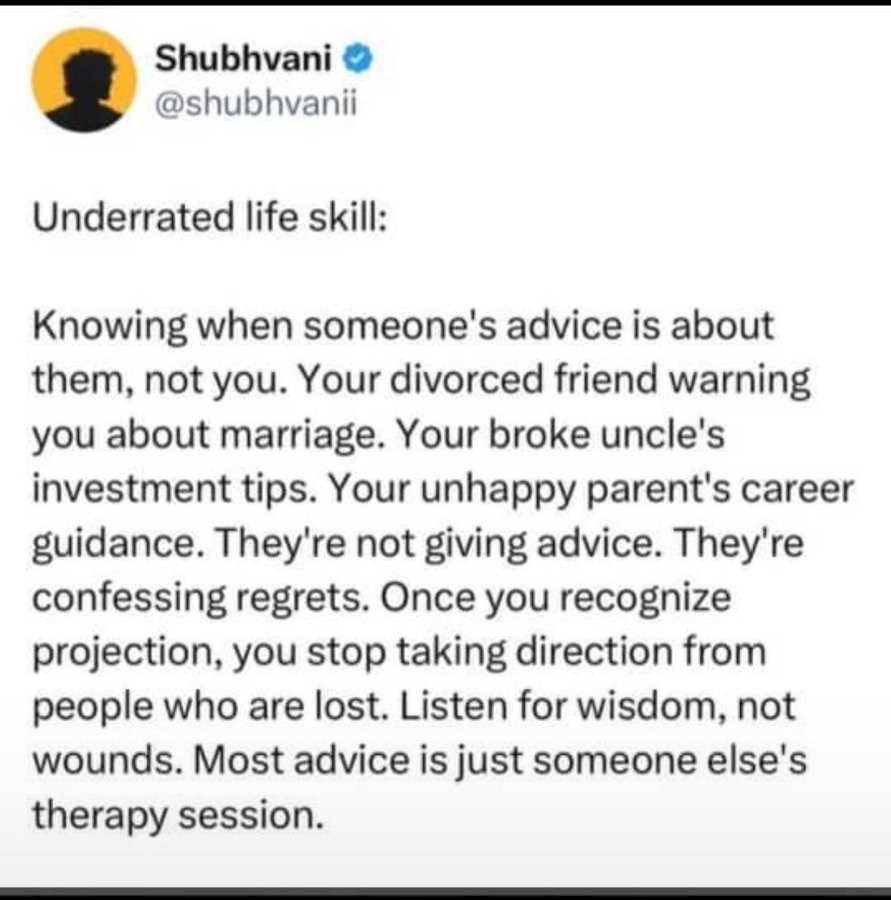
But is it invalid warning?
“I did this and it was a mistake” is definitely useful advice. It might not necessarily be completely applicable to your situation, but learning from other people’s failures can be as useful as learning from other people’s success.
Especially when the most important elements of some people’s success is things like “Have rich parents”
Listening to the regrets of others in the context of their lives is how you get wisdom, at least without first hand experience from making the same mistakes.
I love that I had the same idea as most people in here. You level headed assholes are the best.
I learned from some family and friends without them even saying anything. I just see how they took care of their bodies and how broken they are. A co-worker told me she was sitting on the ground and needed someone to help her stand up. Some can’t walk, can’t bend over, can’t move their arms over their shoulder…Health is wealth. Take care of yourself.
People can give solid advice even when they are struggling or even when they failed in the same area. A smoker can tell you smoking is bad. Someone whose marriage ended can still recognize unhealthy patterns. Someone who made financial mistakes can warn you about the traps they fell into. Two things can be true at the same time.
A useful skill is learning to tell when advice is grounded in reflection versus when it is shaped by unprocessed regret. People often speak from a mix of past experience and current emotion. Some insights are helpful, some are fear driven, and it takes a little judgment to sort out which is which.
So instead of accepting or rejecting advice automatically, it helps to look at where it is coming from. Are they sharing something they have actually thought through, or are they reacting to their own past? The value of the advice depends less on whether their life went well and more on how honestly they have understood it.
I think this is only bad if they don’t recognize their mistakes and just discourage you from even trying to achieve something.
Learning from other people’s mistakes is a useful skill.
So is people learning from their own mistakes, and many people never do. These skills come as a pair. The mistakes don’t have to be yours to learn, but it helps make the lesson far more impactful.
If a man didn’t make mistakes he’d own the world in a month.But if he didn’t profit by his mistakes he wouldn’t own a blessed thing.
-Jesse Livermore
Learning from experience
Those are all experiences they had. Where the fuck else is advice gonna come from? At least someone who had a divorce knows more about marriage than someone who has never even gone on a date.
While true, it’s worth keeping the context in mind. At a work event I got seated with three divorced dudes who had like 6 wives between them. It was insufferable how much “advice” they offered and based on never having even met me before and the fact I was married kept insisting I would figure out my wife was cruel, vindicative, had no respect for me. and was cheating on me. Women were all terrible and a man could only live his best life without women. They were also grateful that when didn’t sit then with any of those “useless women”. I got told repeatedly how I should divorce and never date again.
See, that’s not advice on marriage, tho. I also have been divorced, and she literally was all those things. But I won’t say not to get married. Just don’t get married to my ex; she’ll fuck you up.
If anything, it’s advice on how to be a misersble, lonely bastard.
That is just shitty culture. Unlikely where I am from. Perhaps there is a jaded dude here or there, sure. Ganging up on someone telling them they should divorce? Sounds crazy.
Feel free to tell those people to just shut the hecc up.
Rereading the post, it isn’t that you should ignore the advice of people who failed, but you need to recognize what kind of “advice” you’re getting.
Someone can fail and give you good advice, but the advice described isn’t that.
The way I heard it, and it changed my life, was “All advice is autobiographical.” You have to filter it through your opinion of the person, how self aware they are, and how much you think they’re sincerely trying to think of you when giving advice.
Edit: And, yes, every time I see this discussed there are droves of snarky people thinking they’re being so clever by pointing out the “irony” which I think is really just reflecting their cynicism. Social skills require nuance and understanding that no rule can be applied 100%.
This is the correct interpretation. The post is wrong in how you should view that information. The post is actually a tad cynical and arrogant.
“Be careful whose advice you buy, but be patient with those who supply it. Advice is a form of nostalgia. Dispensing it is a way of fishing the past from the disposal, wiping it off, painting over the ugly parts and recycling it for more than it’s worth” -Baz Luhrmann
Despite randomly saying “Baz Lurhmann” like a vocal tic, I have no idea who he is. I’ve looked it up multiple times.
Guy drops a mean quote tho.
It’s hard to know who exactly to attribute the quote to, but it’s based on this, song? Speech? Something. If you haven’t heard it before, I highly, highly recommend giving it a listen, especially if you are younger. It’s sonething I think everyone deserves to hear before they make their way in the world, and still offers good advice if you’re already in it but feeling lost.
“Everybody’s Free (To Wear Sunscreen)” is a 1999 spoken-word hit by Australian filmmaker Baz Luhrmann, featuring Lee Perry reciting life advice over a remixed track. Based on a 1997 Chicago Tribune column by Mary Schmich, the song offers nostalgic, philosophical advice on life, aging, and happiness, famously advising to always wear sunscreen.
So many of the other heavily upvoted comments are taking the absolutely least charitable interpretation of the comment.
It can be hard to discern what is good or bad advise, especially if you are less experienced, young, and also if the advise came from an authority figure in your life, such as a parent as mentioned in the post. Yes, I am speaking from experience, my parents gave extremely bad advise when I was growing up. How was I supposed to know they’re bad advise to begin with? I was too young to know they’re practically bad until I followed and it put me in trouble. And now as an adult and gained my own experience after countering what they say, it was only then I realised their insistent advise (read: instructions) are projections of their own insecurities and unresolved trauma. I have a schadenfreude now that they regret how they parented. I don’t exactly blame my parents, they grew up in an authoritarian culture where absolute obedience and conformity are paramount. But even so, I am wary if I get kids someday and let my parents babysit them. I don’t know what kind of nonsense they’ll say and teach to the kids, especially that my mom is superstitious.
The problem is that successful people can also give bad advice.
A common one is the Boomer advice of walking into a place, asking to see a manager, and talking with them about getting a job. That strategy might have worked in the 80’s, but it doesn’t work today.
Now that you mentioned it, my mom gives good advise to other people and I was thinking “why don’t you give the same to us?” I kinda realise maybe it’s easier to provide good advise to others as an independent observer, if you don’t have as much personal and emotional attachment to the person.
People learn from mistakes, not success.
Agreed. The OP makes it sound like you should only take advice from successful people, but successful people might just be lucky. We should also be careful to not take investment advice from lottery winners.
I understood it as to recognise when their words are only packaged as “advice” from their bad experience (eg something general, vague, without specific useful logic you can take & apply to other situations, like “never get married”, “never invest”, “never build your own house”, etc).
That is not the same as a fully argumented logic (which the person might indeed have learned from their own mistake), like “if your partner explicitly promised that in the first week of marriage they will steal you money, murder your neighbors & pin it on you, and you would not want that, don’t marry them”.
Basically if someone opens a muffin shop & it goes out of business, and you are thinking of opening a muffin shop (“Muffin tops for muffin bottoms”), you are gonna need to know/understand why & how exactly it went out of business, not just that it went out of business, it’s a huge difference.
(It was in a neighborhood filled with lean muffintopless tops. So tweaking the business model only a little meant huge success.)I disagree with OP in that it has to be trauma tho.
You can get stupid pushy advice what to do just bcs it worked by chance for someone (in a million) decades ago.Yep. In my experience the real trick is to find the value in advice, regardless of who/what/why (as I give this advice haha). For example, we’re trained to call out hypocrites but really, hypocrisy shouldn’t be immediately discounted just because it’s hypocrisy. A drug addict can absolutely tell someone they shouldn’t do drugs. Hypocritical? Yep. Good advice from someone who really knows? Also yep.
Critical thinking is the single most important skill a human can learn.
A drug addict can absolutely tell someone they shouldn’t do drugs. Hypocritical? Yep.
It’s not even hypocritical, the risk of addiction is literally the reason why you shouldn’t even try certain drugs, and the addict not being able to quit even though they know that it’s bad just proves the point.
Just watch out for people projecting their specific problems onto your situation when you don’t have those problems. Mostly a problem with unsolicited “advice”
listen to people who warn you about something that fucked them up.
don’t touch the fire - person with burned hands
A professor once gave me similar advice when I was trying to get into grad school. I repeated a bunch of advice I had heard from other students who were struggling with the same thing, and he said “Why are you listening to them? Go ask the grad students here who have already gotten into grad school.”
It was such obvious advice in retrospect, but it was eye-opening for me at the time, and I’ve applied it to many other parts of life.
There is a difference between “advice” on how to do something vs. “advice” on what to avoid or how not to do it.
I would gladly take advice on how to do something from someone who succeeded, and I’d equally gladly take advice on what not to do from someone who failed.
They are both invaluable.
Rich person’s guide to getting rich: “It’s fairly simple. All it takes is a little bit of hard work, dedication, and an initial investment of five million dollars. I did it, my father did it, and his father and grandfathers did it before him. I come from a long line of self-made millionaires. It must be in our genes.”
You and I have differing definitions of success. 😂
It’s not my definition either, just riffing on a common trope.
Sometimes people who are considered successful at something are bad at teaching it, especially when they faced lower barriers to entry, whether for socioeconomic reasons or because the landscape has changed. A person who entered the workforce 10 or 20 years ago wouldn’t really be able to give good advice for finding an entry-level position in today’s job market. Another classic example is boomers telling millennials to work hard and buy a house.
Sometimes it is because a talent comes so naturally to someone that they don’t know what it’s like to have to struggle to learn it. Can you imagine taking music lessons from Mozart? He’d be like “Just play it! What do you mean you can’t?”
I know I could never tutor anyone in math. People used to ask me to explain how to solve something and I couldn’t comprehend what they didn’t understand about it, so I didn’t know how to start. I would just show them how to solve it, and they’d be like “all you did was solve it, that didn’t make things any clearer.” Well then I don’t know how to help 🤷♀️
I love when fat people tell me to eat 6 times a day, avoid fat and sugar, avoid white bread and pasta, drink and eat light products, yet sneak in a snack now and again to keep up my energy level, and to remember that breakfast is the most important meal of the day.
I have to bite my lip to not blurt out: Yeah, so how’s that working for ya’?
Sounds like this guy keeps getting shitty advice from everyone. I’m not going to listen to someone like that.
“Don’t learn from other people’s mistakes, make your own so you too can become a jaded cunt.”
Sounds like a 5* skill to have…
Learning from your own mistakes is vital for improvement, but learning from other people’s mistakes, so you don’t have to suffer consequences, is a superpower.
Taking advice from people who are demonstrably bad at something, without any critical analysis, is also bad.
It would be nice if the post image included that somewhere instead of making a sweeping generalization.
Yes it’s much better to get advice from people who don’t know what they’re talking about. Because why would you listen to someone who’s divorced about marriage it’s not like they’ve been married, oh wait.
SUPER HELPFULL MISTER SMARTYPANTS< MAYBE TELL ME HOW TO DISTINGUISH THEM FROM EACH OTHER??? HMM?
Sounds more like linkedinlunatics than genuine advice.