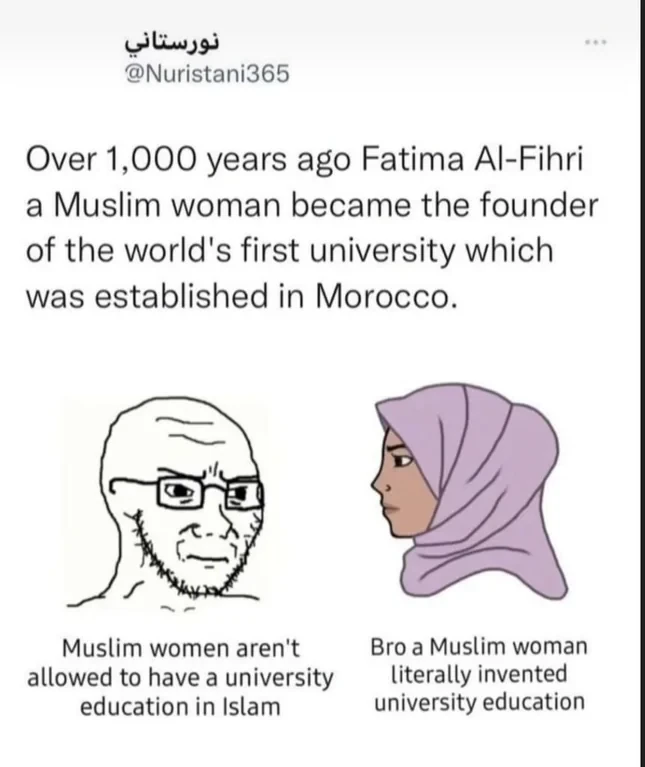

No, she did not. Fun meme though.
https://en.wikipedia.org/wiki/Fatima_al-Fihriya
Here’s a muslim viewpoint:
I went to university in a kaffir country a decade before accepting Islam.
It was a real cesspit. A breeding ground for zina, intoxicants, liberal values, feminism, LGBTQ+ etc. This is your average western University.
Basically, women cannot go to university, especially if they’re beautiful, because that will invariably lead to men getting horny.
Some basement dwelling redditor is your source? In actual muslim countries, such as Jordan, its mostly women who go to university: https://petra.gov.jo/Include/InnerPage.jsp?ID=57929&lang=en&name=en_news https://www.sigi-jordan.org/en/article/6498
Reading the replies, do people think all Muslim countries are one and the same?
The historical accuracy criticism is valid but following with fox-news-style rhetoric “all brown people are religious fanatics” is disingenuous.
Look at Tunis. Since foreign states (fuck France) are not invading them annually, they were able to protest and progress. More than 55% of people in Higher Education are young women over there as a result.
Wikipedia article Women in Tunisia has a section on education including the progress and the current problems they face if anyone wants to read.
Edit : Highly suggest other sections too, article is written great. They go over current inequality in employment and marriage, and also progress in other topics.
This is my favorite part so far.
![[citation needed][5] In 1959, women were able to access birth control. In 1965 a law was passed that allowed women to have abortions as part of a population control policy. [8] Abortion on request was legalized in October 1973.[9]](https://lemmy.world/pictrs/image/8f3ab35f-ec5e-4b2c-b52b-9d35791f5c7b.jpeg)
Yeah, “Fatima probably didn’t exist” is one thing, “It’s only a university if it’s White and Christian before the 19th century” is a whole nother ball of wax.
do people think all Muslim countries are one and the same?
i mean, people generalize shit into monoliths. when it comes to politics, unless you’re pulling out an opinion poll every godsdamned religion gets mashed down into its own little box and there is no variation within it so help me whatever god it’s worshiping.
ITT: “It’s only a University if it comes from the Université region of France, otherwise it’s just sparkling higher learning”
Isn’t that the post?
Higher education predates Islam.
Had to check quick if this was a religiousfruitcake comm

… for having a common meme template pointing out a piece of historical trivia?
Man, I don’t even fucking think religion as a whole is compatible with modern democratic societies, and I have a special hate in my heart for the Abrahamic religions, but this entire comment section has really made me feel like I’ve been tossed a decade or two into the past.
If there was a joke involved instead of an lazy ass eye-rolling apologetic, I’d like it more! See:

I mean, not every meme is a knee-slapper. Plenty of memes here are oriented towards the trivia, with the joke being secondary.
I don’t think “Muslim are way more misogynist now than in the past” is a great reply to “Muslims are very misogynist”.
Most Muslim countries allow women to pursue university education, even theocracies as shitty as Iran, so I presumed the left was representative of a conservative trying to appeal to tradition.
Hell, some of them even allow women to drive cars! How amazing!
The Saudis were the only one with that bizarre ban, and it was lifted almost a decade ago.
Man, I’m not saying the Muslim world doesn’t currently have a problem with misogyny, I’m just fucking pointing out that it’s not the universal Islamic tradition Muslim conservatives claim it is.
What about Plato’s Academy? It was an institution of higher learning, and it certainly existed long before the one in the meme. I’m not saying that the Academy was the first one either, it wouldn’t surprise me if there were others before hand.
It seems to me like the claim “the oldest currently existing university” got converted to “the first university” and those are definitely not the same.
A. It was a mosque. It got converted later to a madrasa, so no, She didn’t found an education center.
B. A madrasa Is the equivalent to a Christian seminary, not a full fledged university
Plato’s Academy definitely did not start as a mosque… So I guess you’re refering to al-Qarawiyyin University.
Islam did a much better job of incorporating science, so it’s not really comparable to a seminary either. It’s not like they only taught theology there. We owe a great deal to the science being done by Muslims in those days. A hell of a lot more happened there than in the Middle Ages in Europe.
Besides, the university of Cambridge also started as a religious institution. I see no difference. All old universities have religious roots I guess? It took a long time for mankind to come up with secular education so why are the Islamic roots even a cause to question the validity of this university?
The University of Taxila predates both Plato’s academy and the instiution in question. The meme makes a somewhat dubious claim. It may be more accurate to say it’s the oldest still operating place of higher learning.
What about Plato’s Academy? It was an institution of higher learning, and it certainly existed long before the one in the meme. I’m not saying that the Academy was the first one either, it wouldn’t surprise me if there were others before hand.
Certainly, if we want to get into the question of who exactly was first, we could probably come up with a few dozen names. That it is very early in the academic tradition is what’s important to the meme and the message.
It seems to me like the claim “the oldest currently existing university” got converted to “the first university” and those are definitely not the same.
I would say “yes-and-no.”
Whatever university has the strongest claim to be the oldest currently existing university probably also counts as the first university, because of the irregularity of the structure of learning institutions in the Classical and pre-Classical era (to the best of our knowledge). Plato’s Academy, which you mentioned, was arguably more of an enduring round-table than an institution with students and teachers, and to our knowledge didn’t have any sort of curriculum. Plato’s Academy was a place where philosophers and important folk got together to mutually intellectually enrich each other, rather than to pass on specific knowledge or competencies.
Generally we consider a university more like a school - with set staff, set students, and a set course of learning; Plato’s Academy had a head, I believe, but not regular teachers or students, and simply discussed matters in a learned way amongst themselves. If you went there ignorant, you would learn something, but attendance and learning, or attendance and teaching, were not synonymous; and you came and went according to when you were satisfied with what you were discovered, rather than there being courses or degrees that could be completed.
China might have a good claim on the oldest university, tbqh, but I couldn’t trace the history there, personally. It’s far from my fields of interest.
Whatever university has the strongest claim to be the oldest currently existing university probably also counts as the first university, because of the irregularity of the structure of learning institutions in the Classical and pre-Classical era (to the best of our knowledge).
That’s a weird argument. So if the University of al-Qarawiyyin stops operating, then some other place becomes the first university?
Generally we consider a university more like a school - with set staff, set students, and a set course of learning
That’s more of a modern understanding of what a university is like (and I doubt it is an accurate description of the mosque that Fatima al-Fihri made).
Academy was a place where philosophers and important folk got together to mutually intellectually enrich each other,
A ‘community of masters and scholars’ one might say, or in latin ‘universitas magistrorum et scholarium’ which is the origin of the word ‘university’. The original point of Universities was the same as that of the Academy. The teaching of students is just a side effect of achieving that goal since teaching is a great way to learn.
That’s a weird argument. So if the University of al-Qarawiyyin stops operating, then some other place becomes the first university?
No, just saying that considering the development of institutions of higher learning, there’s a good chance that the first university and the oldest continuously operating one are one and the same. Not that it necessarily implies that they are one and the same.
That’s more of a modern understanding of what a university is like (and I doubt it is an accurate description of the mosque that Fatima al-Fihri made).
My point here is simply that Plato’s Academy never developed into an institution like that. I’m sure that if it did, none of us would begrudge Plato the honor of being the founder of the world’s oldest university.
A ‘community of masters and scholars’ one might say, or in latin ‘universitas magistrorum et scholarium’ which is the origin of the word ‘university’. The original point of Universities was the same as that of the Academy. The teaching of students is just a side effect of achieving that goal since teaching is a great way to learn.
See, here I have to disagree. The point of universities was to provide a community of masters and scholars, but explicitly for the access of the less-educated in order to perpetuate the knowledge possessed to the next generation, in the same spirit as guilds held masters and journeymen alike. All of the major institutions recognized as universities that I’m aware of (admittedly only a few, it’s not my main field of interest) starting out with this more ‘school-like’ structure, rather than the structure of a round-table of academics. I know several developed out of more traditional church schools.
I mean… It was actually a mosque focused on religious education when it was founded. It didn’t become a an accredited university until the 20th century, but I mean I guess we can move the goal posts some more if we want.
I mean… It was actually a mosque focused on religious education when it was founded.
… do you not understand how other modern universities started?
It didn’t become a an accredited university until the 20th century
… accreditation for universities wasn’t a thing until the 19th century, so I don’t know what you expect that proves?
but I mean I guess we can move the goal posts some more if we want.
You’re tilting at windmills.
You’re not actually addressing the core point.
“…do you not understand how other modern universities started?”
Yes, actually I do. Many universities evolved out of religious institutions. That’s exactly the point. Being founded as a religious school doesn’t automatically make something equivalent to what we now define as a university. Institutions like University of Oxford developed into degree-granting, corporately structured institutions with recognized faculties, charters, and governance systems. Simply saying “others started religious too” skips over the structural differences that define a university.
“…accreditation for universities wasn’t a thing until the 19th century, so I don’t know what you expect that proves?”
Accreditation in the modern sense didn’t exist, sure. But formal recognition, charters, and institutional frameworks absolutely did. Medieval universities operated under papal bulls, royal charters, or legal privileges that formally established them as universities. So the absence of modern accreditation doesn’t mean there were no standards or distinctions at all. The question isn’t “was there 19th-century accreditation?” it’s whether the institution functioned as a university in the historical sense of the term.
Calling that “moving the goalposts” doesn’t make it so. It’s clarifying definitions.
And as for “tilting at windmills” that only works if the argument being challenged doesn’t exist. This at its core is a disagreement about classification and historical continuity. That isn’t imaginary it’s a definitional and historical debate.
If you want to argue it qualifies as a university from inception, then please make the case based on the structure, curriculum, governance, and recognition not just origin story comparisons.
Yes, actually I do. Many universities evolved out of religious institutions. That’s exactly the point. Being founded as a religious school doesn’t automatically make something equivalent to what we now define as a university.
This is your objection, here:
“I mean… It was actually a mosque focused on religious education when it was founded.”
What’s the difference between a Christian institution founded for the purpose of the scholastic study of theology and a Muslim one, other than cultural chauvinism?
Institutions like University of Oxford developed into degree-granting, corporately structured institutions with recognized faculties, charters, and governance systems.
And you think… Al-Qarawiyyin didn’t until, what, the White Man came and Civilized Morocco in the 1960s? Because that’s what you’re saying when you object to Al-Qarawiyyin’s existence as a university until accreditation in the 20th century AD. I guess the diplomas dating back to the early 13th century AD are just a liberal hoax.
Accreditation in the modern sense didn’t exist, sure. But formal recognition, charters, and institutional frameworks absolutely did.
So the pre-20th century formal recognition and institutional frameworks of al-Qarawiyyin don’t get recognition, but all the pre-19th century institutions of European universities do. How very… convenient.
So the absence of modern accreditation doesn’t mean there were no standards or distinctions at all. The question isn’t “was there 19th-century accreditation?” it’s whether the institution functioned as a university in the historical sense of the term.
Funny then that your historical sense of the term university excludes an institution of higher learning with formal recognition, charters, and institutional frameworks, which granted degrees to graduates. But I guess they had a charter from a MUSLIM polity, which was illegitimate; only Christian polities can grant REAL charters. /s
Calling that “moving the goalposts” doesn’t make it so. It’s clarifying definitions.
You utter dipshit, you’re the one who said “moving the goalposts” I made no such accusation.
Fuck’s sake. Can you not keep your own thoughts in order for a single fucking comment?
And as for “tilting at windmills” that only works if the argument being challenged doesn’t exist.
Holy fucking shit, that’s not what tilting at windmills means in this context.
Tilting at windmills as in attacking an argument that has not actually been presented, not that does not exist in the fucking abstract.
You’re arguing against things I didn’t say, and then attributing motives I never expressed.
First, this has nothing to do with Christianity vs. Islam, or “civilizing” narratives. That framing is rhetorical escalation, not argument. The question isn’t whether a Muslim polity can grant a “real” charter. Of course it can. The question is whether the institutional structure at the time matches the historical definition of a university as that term is used by historians.
There’s a difference between:
- A mosque or madrasa centered on religious instruction, even if advanced and prestigious
- And a corporate, self-governing universitas with multiple faculties (law, medicine, arts, theology), standardized curricula, and degree structures
European medieval universities weren’t considered universities merely because they were Christian. They were recognized as such because they developed specific institutional characteristics: legal corporate identity, degree hierarchies (bachelor, master, doctor), cross-disciplinary faculties, and recognized privileges.
If you’re arguing that University of al-Qarawiyyin met those same structural criteria prior to the 20th century, then make that case clearly. Point to its governance model, faculty structure, degree system, and legal status in comparable terms. That’s a historical comparison, not cultural chauvinism.
The existence of diplomas in the 13th century is evidence of credentialing, yes. But credentialing alone does not automatically equal “university” in the specific medieval European sense. Many institutions granted ijazahs (teaching licenses) without being structured as universities in the corporate sense used in Latin Christendom. That’s a structural distinction, not a civilizational hierarchy.
Also, I didn’t accuse you of moving the goalposts in this exchange, I was clarifying it, so correcting me for something I didn’t say is ironic given the complaint about “tilting at windmills.”
As for that phrase: in modern usage, “tilting at windmills” generally means attacking a perceived opponent or mischaracterized position. If you think I mischaracterized your argument, say that directly. But redefining the idiom mid-rant doesn’t strengthen your case.
Strip away the sarcasm and insults, and the real issue is definitional:
Are we using “university” in a broad sense meaning “any advanced institution of higher learning,” or in the narrower historical sense tied to specific medieval corporate structures?
That’s the disagreement. It isn’t about religion. It isn’t about legitimacy of Muslim polities. It’s about institutional classification.
If we can’t keep it at that level, then we’re not debating history, we’re trading accusations.
You’re arguing against things I didn’t say, and then attributing motives I never expressed.
No, I’m arguing against the things you necessarily implied with what you said, and then extrapolating them to their logical, if absurd, conclusions.
First, this has nothing to do with Christianity vs. Islam, or “civilizing” narratives. That framing is rhetorical escalation, not argument.
Oh, so in that fucking case, would you like to withdraw your previous objection about the university not being accredited until the 20th century, when a suitably European accreditation was offered in recognition?
The question isn’t whether a Muslim polity can grant a “real” charter. Of course it can. The question is whether the institutional structure at the time matches the historical definition of a university as that term is used by historians.
Your original argument was that it was originally a religious institution, and that it was not accredited until the 20th century. That very clearly is a statement dismissing the notion of al-Qarawiyyin as a university before that.
Your assertion necessarily includes, then, that al-Qarawiyyin does not meet those criteria before the 20th century, when even a cursory search of the subject disproves that absurdity.
A mosque or madrasa centered on religious instruction, even if advanced and prestigious
And a corporate, self-governing universitas with multiple faculties (law, medicine, arts, theology), standardized curricula, and degree structures
European medieval universities weren’t considered universities merely because they were Christian. They were recognized as such because they developed specific institutional characteristics: legal corporate identity, degree hierarchies (bachelor, master, doctor), cross-disciplinary faculties, and recognized privileges.
If you’re arguing that University of al-Qarawiyyin met those same structural criteria prior to the 20th century, then make that case clearly. Point to its governance model, faculty structure, degree system, and legal status in comparable terms. That’s a historical comparison, not cultural chauvinism.
Okay, congratulations! Now would you like to tell me why you recognize European corporate self-governing institutes of higher learning with multiple faculties and degree structures, but not North African Muslim ones?
The existence of diplomas in the 13th century is evidence of credentialing, yes. But credentialing alone does not automatically equal “university” in the specific medieval European sense. Many institutions granted ijazahs (teaching licenses) without being structured as universities in the corporate sense used in Latin Christendom. That’s a structural distinction, not a civilizational hierarchy.
I’m not talking about teaching licenses. But I’m sure you’ll find another reason under the justification of ‘Latin Christendom’ to change your argument.
Also, I didn’t accuse you of moving the goalposts in this exchange, I was clarifying it, so correcting me for something I didn’t say is ironic given the complaint about “tilting at windmills.”
I mean… It was actually a mosque focused on religious education when it was founded. It didn’t become a an accredited university until the 20th century, but I mean I guess we can move the goal posts some more if we want.
This you? Either you’re unable to read, unable to write coherently, or unable to remember what you said.
As for that phrase: in modern usage, “tilting at windmills” generally means attacking a perceived opponent or mischaracterized position. If you think I mischaracterized your argument, say that directly. But redefining the idiom mid-rant doesn’t strengthen your case.
Holy fucking shit
What the ever-loving fuck do you think
“Tilting at windmills as in attacking an argument that has not actually been presented, not that does not exist in the fucking abstract.”
means?
Please, show me your level of reading comprehension here. What does that quote, from me, mean?
Strip away the sarcasm and insults, and the real issue is definitional:
Are we using “university” in a broad sense meaning “any advanced institution of higher learning,” or in the narrower historical sense tied to specific medieval corporate structures?
Oh, I thought we were discussing degree-granting, corporately structured institutions with recognized faculties, charters, and governance systems. Now it is a specific medieval (and, as you clearly say above, medieval Latin Christendom) instutition? How convenient that now that it’s become apparent that al-Qarawiyyin has a legitimate educational history before the 20th century, you change your definitions again.
That’s the disagreement. It isn’t about religion. It isn’t about legitimacy of Muslim polities. It’s about institutional classification.
Religion and prejudices affect how people see institutions and classifications. Quite clearly, since you’re bending backwards to dismiss al-Qarawiyyin from the category of ‘university’ before the White Man recognized it despite its long history as a degree-granting, corporately structured institution with recognized faculties, charters, and governance systems.
Go ahead. Make your next reply. I’m sure in this one you’ll forget what you said, accuse me of saying things that you said, display a lack of reading comprehension, and then proffer three different new definitions that you can play Motte-and-Bailey with. You know, just like your last reply.
You’re still treating disagreement over classification as if it must stem from prejudice. That leap is doing most of the rhetorical work here.
Let’s slow this down.
My original point referenced two things:
Its founding as a mosque-centered institution of religious learning
Its formal modern accreditation occurring in the 20th century
Neither of those statements automatically equals “therefore it wasn’t legitimate before Europeans approved it.” That’s an inference you’re adding.
You accuse me of shifting definitions, but the definition has actually been consistent: a university in the historical sense is a corporate, self-governing body of scholars with juridical recognition and degree-granting authority embedded in a defined institutional structure.
If al-Qarawiyyin meets that definition in its premodern form, then demonstrate it on those criteria.
What doesn’t advance the argument:
Suggesting that mentioning 20th-century accreditation implies “White Man recognition”
Assuming structural debate equals dismissal of Muslim polities
Treating definitional precision as prejudice
IAt this point the disagreement is very narrow:
Is the term “university” being used: A) descriptively, for any long-standing institution of higher learning that granted advanced credentials or B) technically, for a specific institutional form that originated in medieval Europe and has identifiable structural markers?
That’s the axis of disagreement.
You’re still treating disagreement over classification as if it must stem from prejudice. That leap is doing most of the rhetorical work here.
It’s not a leap, it’s a clear implication of your argument that you’re refusing to address.
Prejudice is not necessarily conscious.
My original point referenced two things:
Its founding as a mosque-centered institution of religious learning
Its formal modern accreditation occurring in the 20th century
Neither of those statements automatically equals “therefore it wasn’t legitimate before Europeans approved it.” That’s an inference you’re adding.
Your post referenced those things with the implication that they disqualified al-Qarawiyyin as a university before the 20th century.
You accuse me of shifting definitions, but the definition has actually been consistent: a university in the historical sense is a corporate, self-governing body of scholars with juridical recognition and degree-granting authority embedded in a defined institutional structure.
Okay, would you mind telling me where in that definition your original points of
Its founding as a mosque-centered institution of religious learning
Its formal modern accreditation occurring in the 20th century
Have anything to do with that definition?
Or have the goalposts changed, and you just don’t want to admit it.
Suggesting that mentioning 20th-century accreditation implies “White Man recognition”
Suggesting that before 20th century accreditation it wasn’t a ‘real’ university, when accreditation is a fairly late development of European civilization absolutely implies that
Assuming structural debate equals dismissal of Muslim polities
Again, it’s not ‘structural debate’, the dismissal of Muslim polities is inherent to your argument, and I legitimately don’t know if you’re a chud who knows this, or legitimately too blinkered to see it.
Treating definitional precision as prejudice
Also again, this is anything but precise. Every point I’ve addressed wherein al-Qarawiyyin has all the aspects of a European university, you’ve ignored in favor of whinging about your prejudice being called it.
Is the term “university” being used: A) descriptively, for any long-standing institution of higher learning that granted advanced credentials or B) technically, for a specific institutional form that originated in medieval Europe and has identifiable structural markers?
Fuck’s sake, this literally and explicitly contradicts your prior arguments.
Oh, god. It’s the people that constantly quote each other, type way too much, and get all upset over little internet things that mean absolutely nothing, but egos are on the line!
And we’re in historymemes, not lemmyshitpost. Bravo, OP.
Yes, we’re in HistoryMemes, not FictionMemes. Dismissing the validity of posted history with spurious arguments is kind of fucking important. Sorry that I’m not the biggest fan of letting misinformation go. Maybe next time someone can claim Columbus proved the Earth is round, and like a good HistoryMemes moderator, I’ll sit there and smile and nod. That’s what history is all about, isn’t it? Spreading misinformation without the horrible fate of someone contradicting you (generic you, I know you aren’t the same person as above)?
It is a statement of fact that it was accredited in the 20th century. Is there any other form of accreditation informal or formal prior to the modern accreditation? That’s what I think aknifeguy was asking/explaining is how I understood which I don’t know if I misread anything or not
I’m not an educated person so bare that in mind please, this whole back and forth between you 2 seems to have gotten quite spicy. I’m just trying to figure out why you are seemingly so angry and hostile to aknifeguy as that’s how you came across to me (again I educated so I’m not qualified to judge your content, just a confused audience member here.)
It is a statement of fact that it was accredited in the 20th century.
It is also a statement of fact that Oxford still isn’t an accredited university.
As another example, my sister got her Bachelor’s in Mechanical Engineering in the 1980’s from Johns Hopkins University and her degree at the time wasn’t accredited. No one cared. It was Johns Hopkins.
Accreditation is like the Better Business Bureau for schools. It means nothing to big businesses but can help consumers identify shady businesses from legitimate companies. Google isn’t BBB accredited because Google doesn’t care. Oxford isn’t acreddited because Oxford doesn’t care.
I can’t speak for Pug, but something they allude to but don’t outright state is that the other person’s position is build not on knowledge, but ignorance one step removed from bigotry. They clearly have massive gaps in their knowledge (if they even know anything about this topic), and rather than educate themselves they make assumptions according to their latent preconception that “the world’s oldest continuously operating higher education institute” is a distinction too good to let filthy Muslims have. Then when the factual flaws in their argument are pointed out they reformulate their argument and repeat the process again. Pug is uniquely… uh… colorful, but being on the opposite end of such an argument about one’s field of interest would I think get most people riled up proportional to their general (in)tolerance for bigotry.
TL;DR: Aknifeguy keeps making assumptions based on what is likely bigotry and pretending they know what they’re talking about rather than googling stuff they don’t know, and this is a good way to piss off people who know what they’re talking about and don’t like bigotry.
It is a statement of fact that it was accredited in the 20th century. Is there any other form of accreditation informal or formal prior to the modern accreditation? That’s what I think aknifeguy was asking/explaining is how I understood which I don’t know if I misread anything or not
Aknifeguy posited that accreditation was only afforded to the university in the 20th century AD, thus implying in the context of the dispute that it could not have been a university before that. The issue is that accreditation itself in that sense only dates to the 19th century AD, yet it is extremely doubtful that he would dismiss Oxford circa 1750 AD as a university for lack of accreditation. The only alternative would be that Aknifeguy is suggesting that informal legitimization before the invention of modern, scholarly accreditation for places of higher learning count if they come from Christian European polities, but not North African Muslim polities.
“There were no universities until the 19th century” or “Informal accreditation counts, but only for the universities I deem fit”
I find neither possibility compelling.
I’m not an educated person so bare that in mind please, this whole back and forth between you 2 seems to have gotten quite spicy. I’m just trying to figure out why you are seemingly so angry and hostile to aknifeguy as that’s how you came across to me (again I educated so I’m not qualified to judge your content, just a confused audience member here.)
I have about one semi-polite reply in me, and I used it up at the start. Having someone accuse me of saying what they said, incorrectly attempt to correct me on an idiom, and, ironically for someone who brought it up at the very start, moving the goalposts of the argument (“It wasn’t accredited and it started as a religious institution” to “Well, it doesn’t fit a much more specific definition of university in which both of those points are entirely irrelevant”) tend to get my dander up; on top of what I regard as the absurd and pedantic nature of the position to begin with that no one would apply to any other founder of notable institutions.
Also, I’m irritable in general.
The University of Oxford was founded in 1096 as a Catholic university with a curriculum in theology and canon law. The University of Cambridge was founded in 1209 by people from the University of Oxford, so also largely clergy. The University of Salamanca was founded in Spain in 1218, also to teach theology and canon law (and, in fairness, some harder sciences as well). The first subjects to be taught at the University of Padua when it was founded in 1222 were law (civil law and canon law) and theology.
And while it’s true that the University of al-Qarawiyyin was founded as a mosque, mosques in that time were well-known and attested as places of learning; there’s evidence that al-Qarawiyyin was a madrasa from the very beginning (and proof of it by the 12th Century at the latest), and while people in European universities try to draw a distinction between the definition of “university” and “madrasa,” there’s no real evidence for a meaningful difference that doesn’t just boil down to “well, they do stuff differently.”
Yes, mosques were major centers of learning, and yes, madrasas were formal institutions of higher scholarship. No serious historian denies that. The question isn’t whether they were sophisticated or prestigious. They clearly were.
The debate is whether the madrasa model functioned as a corporate juridical body in the same way the medieval European universitas did.
Madrasas generally operated through:
Endowments (waqf) Individual scholars granting ijazahs (licenses to teach specific texts) Study circles tied to particular teachers Administrative oversight embedded in religious or political authority
What they typically did not have was:
A single incorporated body of masters and students with collective legal standing A standardized multi-faculty structure under one corporate identity Degree hierarchies equivalent to bachelor/master/doctor conferred by the institution itself rather than by individual scholars
That distinction is structural, not civilizational.
Saying “they do stuff differently” understates the difference. The difference is not about religion or content. It’s about legal personality and corporate organization.
You can absolutely argue that the European definition is too narrow or too culturally specific. That’s a fair historiographical critique. But saying there’s “no meaningful difference” isn’t accurate — there are documented differences in governance, legal status, and credentialing models.
So the real disagreement is this:
Do we define “university” broadly as any enduring institution of advanced learning that granted recognized credentials?
Or do we use the term in its specific medieval legal-institutional sense?
If you choose the broader definition, then al-Qarawiyyin clearly qualifies very early. If you choose the narrower juridical definition, then historians debate whether the madrasa structure fits that category prior to modern reforms.
In short, it’s not a university. And that’s okay. Trying to pigeonhole it into that definition is the issue.
Yes, mosques were major centers of learning, and yes, madrasas were formal institutions of higher scholarship. No serious historian denies that. The question isn’t whether they were sophisticated or prestigious. They clearly were.
So, universities.
Madrasas generally operated through:
Endowments (waqf)
Individual scholars granting ijazahs (licenses to teach specific texts)
Study circles tied to particular teachers
Administrative oversight embedded in religious or political authority
Buddy. You just described Oxford, at least for the first couple hundred years. It’s not 1:1, but it’s very similar.
A single incorporated body of masters and students with collective legal standing
A standardized multi-faculty structure under one corporate identity
Degree hierarchies equivalent to bachelor/master/doctor conferred by the institution itself rather than by individual scholars
Oxford is to this day made up of 43 independent colleges that operate independently, which began as individual teachers teaching their subject. Incidentally, four of those are still today owned by religious institutions.
Do we define “university” broadly as any enduring institution of advanced learning that granted recognized credentials?
Or do we use the term in its specific medieval legal-institutional sense?
I feel like you intended this as a “gotcha,” but that’s literally what I mean by “no meaningful difference.” Especially back in the first millennium.
If you choose the broader definition, then al-Qarawiyyin clearly qualifies very early.
If you choose the narrower juridical definition, then historians debate whether the madrasa structure fits that category prior to modern reforms.
Then you probably have to exclude every university prior to modern reforms. It’s really not worth trying to split hairs for most schools.
In short, it’s not a university. And that’s okay. Trying to pigeonhole it into that definition is the issue.
Yeah, you really thought I was going to agree with you on the obvious answer there, but it really seems obvious to me in the opposite direction.
If you choose the broader definition, then al-Qarawiyyin clearly qualifies very early. If you choose the narrower juridical definition, then historians debate whether the madrasa structure fits that category prior to modern reforms.
In short, it’s not a university. And that’s okay. Trying to pigeonhole it into that definition is the issue.
“If it’s the broader definition, it’s a university. If it’s the narrow definition, it’s debatable. In short, it’s not a university.”
You legitimately don’t see it, do you.
No you don’t see it. It’s not a university. And if we open up the definition then you’re still wrong because Chinese institutions like the Guozijian and Yuelu Academy are older in origins and represent sophisticated, long-running centers of advanced learning.
No you don’t see it. It’s not a university. And if we open up the definition
Of the two definitions you gave in that comment for a university, one you admitted al-Qarawiyyin clearly was a university under; and the other you concede that it is debatable.
then you’re still wrong because Chinese institutions like the Guozijian and Yuelu Academy are older in origins and represent sophisticated, long-running centers of advanced learning.
You didn’t say “It’s not the oldest university”, you said
In short, it’s not a university.
You didn’t say “It’s not the oldest university”.
That’s right. The post you posted said that. But it’s not even a university until 1963. If you broaden the definition the post is still wrong because Chinese institutions would be the oldest.But it’s not even a university until 1963.
…
Moreover (aside: it wasn’t an officially accredited university until the 20th century, but it was a teaching institution ~200 years after its founding), the story itself is doubted by historians.
If the wojak is supposed to be someone pointing out Islam’s consistent, extreme, and baked-in* misogyny regarding women’s education, “well one time 1100 years ago a woman disputably founded a mosque that became an intellectual center 200 years later” isn’t a rebuttal.
Edit: See below re: “baked-in”, as the misogyny isn’t baked directly into education. Thanks to NoneOfUrBusiness for calling me on that.
Islam’s consistent, extreme, and baked-in misogyny regarding women’s education
That literally doesn’t exist. There’s plenty of legitimate criticism of Islam in that regard, but what little it says about women’s education is supportive. Automatically tying Muslims’ (very real to be clear) misogyny to Islam is fallacious logic; people can follow a conservative religion and be conservative in ways that have nothing to do with that religion (or actively contradict it).
I’ve retracted “baked-in” regarding specifically education, having read more about the history, and I appreciate your comment calling me out. However, it’s clear that the current status of women’s education in the Muslim world is a direct result of Islam’s baked-in complementarian misogyny.
Genuine question: What is the current status of women’s education in the Muslim world? Do you have some kind of statistic you’re going off here? The only thing that comes to mind is Afghanistan and everyone thinks those guys are nuts.
My understanding is that it’s improving but that girls still face serious, disproportionate hurdles. When I remarked about the current poor state, one of the sources I’d read was this conference last year by the Muslim World League (largely funded by Saudi Arabia but understood to be a voice of moderation) who insisted that it’s still a major problem worldwide legally and culturally.
Yeah it’s definitely a problem in absolute terms, but what I was getting at is whether it’s comparatively a problem; otherwise we can’t pin the cause down on a certain factor. It could instead be an issue of development. It’s not the exact same thing, but plenty of Muslim countries have low literacy gender gaps, and predictably this is more present in wealthier countries rather than more secular countries. In general it’s better to look for structural explanations to these things rather than blaming culture or religion.
I mean, I thought the wojack was supposed to represent modern conservative muslim men. But still, not a great argument either way.
It was actually a mosque focused on religious education when it was founded.
pack it up boys, I guess theology isn’t something you can get a university degree in.
As we all know, such luminous names as Oxford and the University of Paris have no origins in religion. /s
Oxford and University of Paris aren’t even accredited universities. They assign degrees based on royal charter, not peer review by other institutions.
And? so was Durham University, and Cambridge, and Oxford.
Yeah, I was wondering how they defined “university”. Like, should we count hanging out at Socrates house to be going to university? It makes more sense that they mean “An institution that is now an accredited university and has been an institution in some form for a very long time.” But it kinda deflates the argument a bit…
Probably an institution of higher learning with regular teachers and students, and the graduation of students from a regular ‘course’ of study, rather than purely ad hoc.
ITT: LOTS of people mad about this for pedantic reasons supported by circular reasoning
History Memes raging at clouds
From Wikipedia:
According to the widely circulated narrative, the school linked with al-Qarawiyyin ultimately became the focal point of the present-day University of al-Qarawiyyin. The assertion that the university was founded by Fatima al-Fihri alongside the mosque is not clearly rooted in historical evidence.[22] The university library, linked to Fatima’s story, was restored and reopened in 2016, gaining attention from influential sources such as The Guardian, Smithsonian, TED, and Quartz that claimed that the library was the world’s oldest continuously operating library, and that it was founded by Fatima herself. According to Ian D. Morris, a historian of early Islamic societies, there is no empirical evidence to support claims that Fatima founded the library.[23] The lack of historical sources and consultation with historians by commentators, including think-tanks, NGOs, social scientists, journalists, and bloggers, has resulted in numerous “sourceless, baseless” iterations of the Fatima story. As the story is useful to present-day discourses about women and sciences in Islamic history, Morris concludes that the speculation repeated by modern writers “says more about the current value of Fatima as a political symbol than about the historical person herself.”
Idk if it’s true or not but it checks all of the boxes for misinformation spread in liberal circles.
According to the widely circulated narrative, the school linked with al-Qarawiyyin ultimately became the focal point of the present-day University of al-Qarawiyyin. The assertion that the university was founded by Fatima al-Fihri alongside the mosque is not clearly rooted in historical evidence.[22] The university library, linked to Fatima’s story, was restored and reopened in 2016, gaining attention from influential sources such as The Guardian, Smithsonian, TED, and Quartz that claimed that the library was the world’s oldest continuously operating library, and that it was founded by Fatima herself. According to Ian D. Morris, a historian of early Islamic societies, there is no empirical evidence to support claims that Fatima founded the library.[23] The lack of historical sources and consultation with historians by commentators, including think-tanks, NGOs, social scientists, journalists, and bloggers, has resulted in numerous “sourceless, baseless” iterations of the Fatima story. As the story is useful to present-day discourses about women and sciences in Islamic history, Morris concludes that the speculation repeated by modern writers “says more about the current value of Fatima as a political symbol than about the historical person herself.”
If you check the source cited, the position taken by the author in question is very pedantic. He asserts that as the library was not specifically mentioned as part of the mosque in the earliest records, it should not be regarded that Fatima founded the educational institution; and that he doubts that the educational regime would have been ‘advanced’ enough for him to consider it a university at the time. This ignores the very real continuity of religious institutions of the period, especially Muslim religious institutions which placed a high value on scholarship and literacy, with learning and teaching. We recognize founders in other contexts who planted the seed rather than planning out the full end-product all the time. But when it’s a Muslim and a woman, suddenly specifics become vital.
Idk if it’s true or not but it checks all of the boxes for misinformation spread in liberal circles.
Lord. What irony.
I don’t think that’s an accurate summary of the authors findings. He says she likely founded a mosque, and there is zero evidence from midevial sources and earlier, that she did anything more than that (it’s worth pointing out that her very existence is disputed by some historians because there are no references to her until centuries after her death). It’s impossible to prove a negative, but there is no evidence the mosque operated as either a library or a university at the time of its founding. So again, I can’t debunk this- nobody can - I just think it’s pretty flimsy. I could claim the world’s first university was an Egyptian temple, because they probably taught things there.
I dont think it’s fair to say people are being overly pedantic because she was a Muslim women when the only reason this is getting shared in the first place is because she was Muslim woman.
I don’t think that’s an accurate summary of the authors findings. He says she likely founded a mosque, and there is zero evidence from midevial sources and earlier, that she did anything more than that (it’s worth pointing out that her very existence is disputed by some historians because there are no references to her until centuries after her death). It’s impossible to prove a negative, but there is no evidence the mosque operated as either a library or a university at the time of its founding.
The issue is that mosques in that period are synonymous with schooling and text storage in the context of North African Islamic polities. The objection then, necessarily, is either “It’s not certain that it taught the ‘right’ subjects to be a university immediately, therefore, we can dismiss Fatima as founder” or “Storage of academic and literary texts only counts as having a library if it’s a specialized building, otherwise it’s just a sparkling shelf.”
So again, I can’t debunk this- nobody can - I just think it’s pretty flimsy. I could claim the world’s first university was an Egyptian temple, because they probably taught things there.
Some issues with this:
-
You could… if there was an Egyptian temple in continuous usage to the modern day that you could point to, with a long and uninterrupted history of operating as an institute of learning that has the features we generally recognize as belonging to a university.
-
Egyptian temples were used for textual storage (mostly records), but largely not teaching. Medieval Islamic mosques had a very core focus on learning, not just Friday Prayers and the Quran.
-
Al-Qarawiyyin is decisively recognized as a university now; the question of whether it ‘counts’ as a university is settled, the only question, then, is should the founder who created an institute for the purpose of learning, teaching, and information retention, be recognized as its founder, or should they not for some arbitrary criteria that we wouldn’t apply to any other institution or founder?
I dont think it’s fair to say people are being overly pedantic because she was a Muslim women when the only reason this is getting shared in the first place is because she was Muslim woman.
It’s entirely fair to say people are being overly pedantic because she’s a Muslim woman when it’s shared because she’s a Muslim woman. How that does follow?
If I brought up a Black inventor who made something in a way that we would recognizably understand as having invented something, and the response was “Well that Black inventor didn’t REALLY invent it, the concept and previous prototypes were already there”, would it be unfair to point out that that’s a pedantic position, simply because the inventor was brought up because he was Black? What about if the person making the response recognized other inventors as normal, even though almost all of them had established concepts and prototypes which came before them? Would you dismiss any possibility of pedantry being related to racism in that case?
My point was, and is, that you should always be skeptical of feel-good facts shared in image format on social media. The worlds oldest continuously operating university being founded by a Muslim woman is pretty cool - so why have I not heard it before? If you told me it was actually founded by [random European guy], I would probably just believe you because there isn’t really any reason for misrepresent or make up that story. However, there is a pretty clear incentive to distort or embellish the story of Fatima because it pushes back against the narrative of Islam being misogynistic and anti-science. I’m not really trying to be pedantic here, just skeptical of the whole story in general. If a black inventor did something… at least we can agree they did it, and I don’t really care about semantic arguments. I agree that people disputing black people being inventors based on pedantic arguments may be motivated by racism, but that’s not what I’m trying to do here. If there was clear evidence that
a) Fatima was a real person, and
b) There was any evidence that, at the time of its founding, al-Qarawiyyin mosque was a center of learning,
I wouldn’t really care about whether or not you could really consider it a “university” or not, and would be happy to consider her the founder of the oldest continuously operating university. However, the reality is that there aren’t any historical records of Fatima until 500 years after her death, which makes her seem more like Dido of Carthage or Romulus than a real person. (Also, they literally found an inscription, believed to be 9th-century, within the mosque that says it was founded by someone else). Also, while madrasas were definitely centers of learning, all the sources I could find say the transition to a madrasa happened after the mosque was founded.
So idk man. It’s not outright misinformation but it is disputed by historians for several reasons.
My point was, and is, that you should always be skeptical of feel-good facts shared in image format on social media. The worlds oldest continuously operating university being founded by a Muslim woman is pretty cool - so why have I not heard it before?
Because it’s a minor piece of trivia? Because we’re undoing some ~200 years of Eurocentric history-as-a-discipline here in the West?
If you told me it was actually founded by [random European guy], I would probably just believe you because there isn’t really any reason for misrepresent or make up that story. However, there is a pretty clear incentive to distort or embellish the story of Fatima because it pushes back against the narrative of Islam being misogynistic and anti-science.
… that’s exactly what I mean when I reference prejudices coloring our interpretations of institutions. If it was a European guy, you wouldn’t even question it.
Islam gained a reputation as exceptionally misogynistic and anti-scientific only in the last 200-300 years.
If there was clear evidence that
a) Fatima was a real person, and
b) There was any evidence that, at the time of its founding, al-Qarawiyyin mosque was a center of learning,
I wouldn’t really care about whether or not you could really consider it a “university” or not, and would be happy to consider her the founder of the oldest continuously operating university.
That’s fair.
A is the part most open to dispute - while generally it’s considered that figures mentioned in historical sources are based on real people, there is always a question of the reliability of transmission, and the source in question is not the most reliable.
B is more reliable - major mosques of the period that were founded by a patron are deeply connected with learning and education, due to the emphasis in Islam on interpretation of holy texts and decentralized religious authority (even under the Caliphate), and it’s clear from a very early point that it was engaged in higher scholarship. You could separate the two - that just because mosques were created as centers of (religious) learning and textual transmission doesn’t mean that it deserves the association with higher scholarship, but I feel like that’s splitting hairs.
That’s a fair rebuttal. Thank you for engaging with me civilly, it makes these discussions a lot more productive and enjoyable.
-
Does it matter how Muslim women today are treated in,say, Afghanistan, or any Muslim country where women are suppressed, that a Muslim woman founded a university 1000 years ago?
Muslim women world wide are denied entry in universities (not to mention being denied countless of other basic rights), you can’t simply wash that away with saying “but a woman for under a Muslim university!”, it sounds the same like “but I have a black friend!”
The point is not “Misogyny is Muslim countries now is okay, because Muslim women were once involved in higher education”, the point is “The appeal of some Islamic misogynists to a tradition of educational misogyny is extremely dubious even from a very early point in Muslim history.”
The appeal of Muslims to literally anything in the Quran is extremely dubious.
You don’t need to be Muslim to have a moral framework.
I mean that the appeal does not hold up even inside the philosophical framework of a ‘traditional’ Islamic society. Especially as the Quran does not forbid women’s education.
Why are there so many complaints in this thread lol.
Islamic countries have also had their fair share of female PMs and presidents both good and bad.
People just seem mad that current academic traditions like graduation gowns and class structure originated from the Islamic Golden Age.
Nothing wrong with history
Some people on Lemmy are just stuck in their bigotic, early 2010s, new atheism/sceptic phase.
have complaint about current average treatment of women in Muslim countries
Aahh, you’re just an edgy atheist! Didn’t you know that a Muslim woman founded a university a thousand years ago?
Yeah, that … Makes a lot of sense when you’re an Olympian level mental gymnast
Not even. They seem to be fine with Christian institutions. More the mid-2010s Jordan Peterson Christianity Apologist phase.