“…do you not understand how other modern universities started?”
Yes, actually I do. Many universities evolved out of religious institutions. That’s exactly the point. Being founded as a religious school doesn’t automatically make something equivalent to what we now define as a university. Institutions like University of Oxford developed into degree-granting, corporately structured institutions with recognized faculties, charters, and governance systems. Simply saying “others started religious too” skips over the structural differences that define a university.
“…accreditation for universities wasn’t a thing until the 19th century, so I don’t know what you expect that proves?”
Accreditation in the modern sense didn’t exist, sure. But formal recognition, charters, and institutional frameworks absolutely did. Medieval universities operated under papal bulls, royal charters, or legal privileges that formally established them as universities. So the absence of modern accreditation doesn’t mean there were no standards or distinctions at all. The question isn’t “was there 19th-century accreditation?” it’s whether the institution functioned as a university in the historical sense of the term.
Calling that “moving the goalposts” doesn’t make it so. It’s clarifying definitions.
And as for “tilting at windmills” that only works if the argument being challenged doesn’t exist. This at its core is a disagreement about classification and historical continuity. That isn’t imaginary it’s a definitional and historical debate.
If you want to argue it qualifies as a university from inception, then please make the case based on the structure, curriculum, governance, and recognition not just origin story comparisons.
Yes, actually I do. Many universities evolved out of religious institutions. That’s exactly the point. Being founded as a religious school doesn’t automatically make something equivalent to what we now define as a university.
This is your objection, here:
“I mean… It was actually a mosque focused on religious education when it was founded.”
What’s the difference between a Christian institution founded for the purpose of the scholastic study of theology and a Muslim one, other than cultural chauvinism?
Institutions like University of Oxford developed into degree-granting, corporately structured institutions with recognized faculties, charters, and governance systems.
And you think… Al-Qarawiyyin didn’t until, what, the White Man came and Civilized Morocco in the 1960s? Because that’s what you’re saying when you object to Al-Qarawiyyin’s existence as a university until accreditation in the 20th century AD. I guess the diplomas dating back to the early 13th century AD are just a liberal hoax.
Accreditation in the modern sense didn’t exist, sure. But formal recognition, charters, and institutional frameworks absolutely did.
So the pre-20th century formal recognition and institutional frameworks of al-Qarawiyyin don’t get recognition, but all the pre-19th century institutions of European universities do. How very… convenient.
So the absence of modern accreditation doesn’t mean there were no standards or distinctions at all. The question isn’t “was there 19th-century accreditation?” it’s whether the institution functioned as a university in the historical sense of the term.
Funny then that your historical sense of the term university excludes an institution of higher learning with formal recognition, charters, and institutional frameworks, which granted degrees to graduates. But I guess they had a charter from a MUSLIM polity, which was illegitimate; only Christian polities can grant REAL charters. /s
Calling that “moving the goalposts” doesn’t make it so. It’s clarifying definitions.
You utter dipshit, you’re the one who said “moving the goalposts” I made no such accusation.
Fuck’s sake. Can you not keep your own thoughts in order for a single fucking comment?
And as for “tilting at windmills” that only works if the argument being challenged doesn’t exist.
Holy fucking shit, that’s not what tilting at windmills means in this context.
Tilting at windmills as in attacking an argument that has not actually been presented, not that does not exist in the fucking abstract.
You’re arguing against things I didn’t say, and then attributing motives I never expressed.
First, this has nothing to do with Christianity vs. Islam, or “civilizing” narratives. That framing is rhetorical escalation, not argument. The question isn’t whether a Muslim polity can grant a “real” charter. Of course it can. The question is whether the institutional structure at the time matches the historical definition of a university as that term is used by historians.
There’s a difference between:
A mosque or madrasa centered on religious instruction, even if advanced and prestigious
And a corporate, self-governing universitas with multiple faculties (law, medicine, arts, theology), standardized curricula, and degree structures
European medieval universities weren’t considered universities merely because they were Christian. They were recognized as such because they developed specific institutional characteristics: legal corporate identity, degree hierarchies (bachelor, master, doctor), cross-disciplinary faculties, and recognized privileges.
If you’re arguing that University of al-Qarawiyyin met those same structural criteria prior to the 20th century, then make that case clearly. Point to its governance model, faculty structure, degree system, and legal status in comparable terms. That’s a historical comparison, not cultural chauvinism.
The existence of diplomas in the 13th century is evidence of credentialing, yes. But credentialing alone does not automatically equal “university” in the specific medieval European sense. Many institutions granted ijazahs (teaching licenses) without being structured as universities in the corporate sense used in Latin Christendom. That’s a structural distinction, not a civilizational hierarchy.
Also, I didn’t accuse you of moving the goalposts in this exchange, I was clarifying it, so correcting me for something I didn’t say is ironic given the complaint about “tilting at windmills.”
As for that phrase: in modern usage, “tilting at windmills” generally means attacking a perceived opponent or mischaracterized position. If you think I mischaracterized your argument, say that directly. But redefining the idiom mid-rant doesn’t strengthen your case.
Strip away the sarcasm and insults, and the real issue is definitional:
Are we using “university” in a broad sense meaning “any advanced institution of higher learning,” or in the narrower historical sense tied to specific medieval corporate structures?
That’s the disagreement. It isn’t about religion. It isn’t about legitimacy of Muslim polities. It’s about institutional classification.
If we can’t keep it at that level, then we’re not debating history, we’re trading accusations.
You’re arguing against things I didn’t say, and then attributing motives I never expressed.
No, I’m arguing against the things you necessarily implied with what you said, and then extrapolating them to their logical, if absurd, conclusions.
First, this has nothing to do with Christianity vs. Islam, or “civilizing” narratives. That framing is rhetorical escalation, not argument.
Oh, so in that fucking case, would you like to withdraw your previous objection about the university not being accredited until the 20th century, when a suitably European accreditation was offered in recognition?
The question isn’t whether a Muslim polity can grant a “real” charter. Of course it can. The question is whether the institutional structure at the time matches the historical definition of a university as that term is used by historians.
Your original argument was that it was originally a religious institution, and that it was not accredited until the 20th century. That very clearly is a statement dismissing the notion of al-Qarawiyyin as a university before that.
Your assertion necessarily includes, then, that al-Qarawiyyin does not meet those criteria before the 20th century, when even a cursory search of the subject disproves that absurdity.
A mosque or madrasa centered on religious instruction, even if advanced and prestigious
And a corporate, self-governing universitas with multiple faculties (law, medicine, arts, theology), standardized curricula, and degree structures
European medieval universities weren’t considered universities merely because they were Christian. They were recognized as such because they developed specific institutional characteristics: legal corporate identity, degree hierarchies (bachelor, master, doctor), cross-disciplinary faculties, and recognized privileges.
If you’re arguing that University of al-Qarawiyyin met those same structural criteria prior to the 20th century, then make that case clearly. Point to its governance model, faculty structure, degree system, and legal status in comparable terms. That’s a historical comparison, not cultural chauvinism.
Okay, congratulations! Now would you like to tell me why you recognize European corporate self-governing institutes of higher learning with multiple faculties and degree structures, but not North African Muslim ones?
The existence of diplomas in the 13th century is evidence of credentialing, yes. But credentialing alone does not automatically equal “university” in the specific medieval European sense. Many institutions granted ijazahs (teaching licenses) without being structured as universities in the corporate sense used in Latin Christendom. That’s a structural distinction, not a civilizational hierarchy.
I’m not talking about teaching licenses. But I’m sure you’ll find another reason under the justification of ‘Latin Christendom’ to change your argument.
Also, I didn’t accuse you of moving the goalposts in this exchange, I was clarifying it, so correcting me for something I didn’t say is ironic given the complaint about “tilting at windmills.”
I mean… It was actually a mosque focused on religious education when it was founded. It didn’t become a an accredited university until the 20th century, but I mean I guess we can move the goal posts some more if we want.
This you? Either you’re unable to read, unable to write coherently, or unable to remember what you said.
As for that phrase: in modern usage, “tilting at windmills” generally means attacking a perceived opponent or mischaracterized position. If you think I mischaracterized your argument, say that directly. But redefining the idiom mid-rant doesn’t strengthen your case.
Holy fucking shit
What the ever-loving fuck do you think
“Tilting at windmills as in attacking an argument that has not actually been presented, not that does not exist in the fucking abstract.”
means?
Please, show me your level of reading comprehension here. What does that quote, from me, mean?
Strip away the sarcasm and insults, and the real issue is definitional:
Are we using “university” in a broad sense meaning “any advanced institution of higher learning,” or in the narrower historical sense tied to specific medieval corporate structures?
Oh, I thought we were discussing degree-granting, corporately structured institutions with recognized faculties, charters, and governance systems. Now it is a specific medieval (and, as you clearly say above, medieval Latin Christendom) instutition? How convenient that now that it’s become apparent that al-Qarawiyyin has a legitimate educational history before the 20th century, you change your definitions again.
That’s the disagreement. It isn’t about religion. It isn’t about legitimacy of Muslim polities. It’s about institutional classification.
Religion and prejudices affect how people see institutions and classifications. Quite clearly, since you’re bending backwards to dismiss al-Qarawiyyin from the category of ‘university’ before the White Man recognized it despite its long history as a degree-granting, corporately structured institution with recognized faculties, charters, and governance systems.
Go ahead. Make your next reply. I’m sure in this one you’ll forget what you said, accuse me of saying things that you said, display a lack of reading comprehension, and then proffer three different new definitions that you can play Motte-and-Bailey with. You know, just like your last reply.
You’re still treating disagreement over classification as if it must stem from prejudice. That leap is doing most of the rhetorical work here.
Let’s slow this down.
My original point referenced two things:
Its founding as a mosque-centered institution of religious learning
Its formal modern accreditation occurring in the 20th century
Neither of those statements automatically equals “therefore it wasn’t legitimate before Europeans approved it.” That’s an inference you’re adding.
You accuse me of shifting definitions, but the definition has actually been consistent: a university in the historical sense is a corporate, self-governing body of scholars with juridical recognition and degree-granting authority embedded in a defined institutional structure.
If al-Qarawiyyin meets that definition in its premodern form, then demonstrate it on those criteria.
What doesn’t advance the argument:
Suggesting that mentioning 20th-century accreditation implies “White Man recognition”
Assuming structural debate equals dismissal of Muslim polities
Treating definitional precision as prejudice
IAt this point the disagreement is very narrow:
Is the term “university” being used:
A) descriptively, for any long-standing institution of higher learning that granted advanced credentials
or
B) technically, for a specific institutional form that originated in medieval Europe and has identifiable structural markers?
You’re still treating disagreement over classification as if it must stem from prejudice. That leap is doing most of the rhetorical work here.
It’s not a leap, it’s a clear implication of your argument that you’re refusing to address.
Prejudice is not necessarily conscious.
My original point referenced two things:
Its founding as a mosque-centered institution of religious learning
Its formal modern accreditation occurring in the 20th century
Neither of those statements automatically equals “therefore it wasn’t legitimate before Europeans approved it.” That’s an inference you’re adding.
Your post referenced those things with the implication that they disqualified al-Qarawiyyin as a university before the 20th century.
You accuse me of shifting definitions, but the definition has actually been consistent: a university in the historical sense is a corporate, self-governing body of scholars with juridical recognition and degree-granting authority embedded in a defined institutional structure.
Okay, would you mind telling me where in that definition your original points of
Its founding as a mosque-centered institution of religious learning
Its formal modern accreditation occurring in the 20th century
Have anything to do with that definition?
Or have the goalposts changed, and you just don’t want to admit it.
Suggesting that mentioning 20th-century accreditation implies “White Man recognition”
Suggesting that before 20th century accreditation it wasn’t a ‘real’ university, when accreditation is a fairly late development of European civilization absolutely implies that
Assuming structural debate equals dismissal of Muslim polities
Again, it’s not ‘structural debate’, the dismissal of Muslim polities is inherent to your argument, and I legitimately don’t know if you’re a chud who knows this, or legitimately too blinkered to see it.
Treating definitional precision as prejudice
Also again, this is anything but precise. Every point I’ve addressed wherein al-Qarawiyyin has all the aspects of a European university, you’ve ignored in favor of whinging about your prejudice being called it.
Is the term “university” being used: A) descriptively, for any long-standing institution of higher learning that granted advanced credentials or B) technically, for a specific institutional form that originated in medieval Europe and has identifiable structural markers?
Fuck’s sake, this literally and explicitly contradicts your prior arguments.
Prove it’s a university. You can’t because it’s not and wasn’t until the 20th century. Maybe if you weren’t chronically online you might actually know something about it.
Oh, god. It’s the people that constantly quote each other, type way too much, and get all upset over little internet things that mean absolutely nothing, but egos are on the line!
And we’re in historymemes, not lemmyshitpost. Bravo, OP.
Yes, we’re in HistoryMemes, not FictionMemes. Dismissing the validity of posted history with spurious arguments is kind of fucking important. Sorry that I’m not the biggest fan of letting misinformation go. Maybe next time someone can claim Columbus proved the Earth is round, and like a good HistoryMemes moderator, I’ll sit there and smile and nod. That’s what history is all about, isn’t it? Spreading misinformation without the horrible fate of someone contradicting you (generic you, I know you aren’t the same person as above)?
It is a statement of fact that it was accredited in the 20th century. Is there any other form of accreditation informal or formal prior to the modern accreditation? That’s what I think aknifeguy was asking/explaining is how I understood which I don’t know if I misread anything or not
I’m not an educated person so bare that in mind please, this whole back and forth between you 2 seems to have gotten quite spicy. I’m just trying to figure out why you are seemingly so angry and hostile to aknifeguy as that’s how you came across to me (again I educated so I’m not qualified to judge your content, just a confused audience member here.)
It is a statement of fact that it was accredited in the 20th century.
It is also a statement of fact that Oxford still isn’t an accredited university.
As another example, my sister got her Bachelor’s in Mechanical Engineering in the 1980’s from Johns Hopkins University and her degree at the time wasn’t accredited. No one cared. It was Johns Hopkins.
Accreditation is like the Better Business Bureau for schools. It means nothing to big businesses but can help consumers identify shady businesses from legitimate companies. Google isn’t BBB accredited because Google doesn’t care. Oxford isn’t acreddited because Oxford doesn’t care.
I can’t speak for Pug, but something they allude to but don’t outright state is that the other person’s position is build not on knowledge, but ignorance one step removed from bigotry. They clearly have massive gaps in their knowledge (if they even know anything about this topic), and rather than educate themselves they make assumptions according to their latent preconception that “the world’s oldest continuously operating higher education institute” is a distinction too good to let filthy Muslims have. Then when the factual flaws in their argument are pointed out they reformulate their argument and repeat the process again. Pug is uniquely… uh… colorful, but being on the opposite end of such an argument about one’s field of interest would I think get most people riled up proportional to their general (in)tolerance for bigotry.
TL;DR: Aknifeguy keeps making assumptions based on what is likely bigotry and pretending they know what they’re talking about rather than googling stuff they don’t know, and this is a good way to piss off people who know what they’re talking about and don’t like bigotry.
It is a statement of fact that it was accredited in the 20th century. Is there any other form of accreditation informal or formal prior to the modern accreditation? That’s what I think aknifeguy was asking/explaining is how I understood which I don’t know if I misread anything or not
Aknifeguy posited that accreditation was only afforded to the university in the 20th century AD, thus implying in the context of the dispute that it could not have been a university before that. The issue is that accreditation itself in that sense only dates to the 19th century AD, yet it is extremely doubtful that he would dismiss Oxford circa 1750 AD as a university for lack of accreditation. The only alternative would be that Aknifeguy is suggesting that informal legitimization before the invention of modern, scholarly accreditation for places of higher learning count if they come from Christian European polities, but not North African Muslim polities.
“There were no universities until the 19th century” or “Informal accreditation counts, but only for the universities I deem fit”
I find neither possibility compelling.
I’m not an educated person so bare that in mind please, this whole back and forth between you 2 seems to have gotten quite spicy. I’m just trying to figure out why you are seemingly so angry and hostile to aknifeguy as that’s how you came across to me (again I educated so I’m not qualified to judge your content, just a confused audience member here.)
I have about one semi-polite reply in me, and I used it up at the start. Having someone accuse me of saying what they said, incorrectly attempt to correct me on an idiom, and, ironically for someone who brought it up at the very start, moving the goalposts of the argument (“It wasn’t accredited and it started as a religious institution” to “Well, it doesn’t fit a much more specific definition of university in which both of those points are entirely irrelevant”) tend to get my dander up; on top of what I regard as the absurd and pedantic nature of the position to begin with that no one would apply to any other founder of notable institutions.


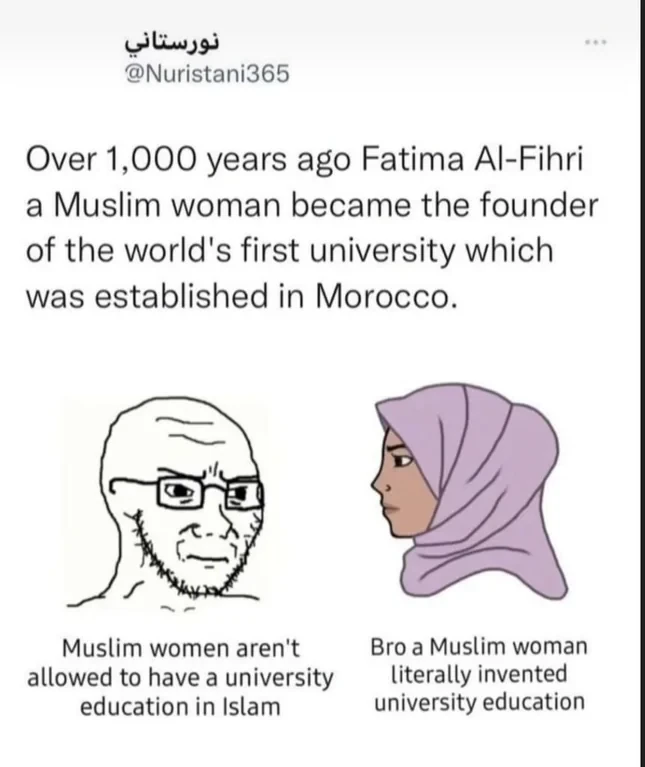
… do you not understand how other modern universities started?
… accreditation for universities wasn’t a thing until the 19th century, so I don’t know what you expect that proves?
You’re tilting at windmills.
You’re not actually addressing the core point.
Yes, actually I do. Many universities evolved out of religious institutions. That’s exactly the point. Being founded as a religious school doesn’t automatically make something equivalent to what we now define as a university. Institutions like University of Oxford developed into degree-granting, corporately structured institutions with recognized faculties, charters, and governance systems. Simply saying “others started religious too” skips over the structural differences that define a university.
Accreditation in the modern sense didn’t exist, sure. But formal recognition, charters, and institutional frameworks absolutely did. Medieval universities operated under papal bulls, royal charters, or legal privileges that formally established them as universities. So the absence of modern accreditation doesn’t mean there were no standards or distinctions at all. The question isn’t “was there 19th-century accreditation?” it’s whether the institution functioned as a university in the historical sense of the term.
Calling that “moving the goalposts” doesn’t make it so. It’s clarifying definitions.
And as for “tilting at windmills” that only works if the argument being challenged doesn’t exist. This at its core is a disagreement about classification and historical continuity. That isn’t imaginary it’s a definitional and historical debate.
If you want to argue it qualifies as a university from inception, then please make the case based on the structure, curriculum, governance, and recognition not just origin story comparisons.
This is your objection, here:
What’s the difference between a Christian institution founded for the purpose of the scholastic study of theology and a Muslim one, other than cultural chauvinism?
And you think… Al-Qarawiyyin didn’t until, what, the White Man came and Civilized Morocco in the 1960s? Because that’s what you’re saying when you object to Al-Qarawiyyin’s existence as a university until accreditation in the 20th century AD. I guess the diplomas dating back to the early 13th century AD are just a liberal hoax.
So the pre-20th century formal recognition and institutional frameworks of al-Qarawiyyin don’t get recognition, but all the pre-19th century institutions of European universities do. How very… convenient.
Funny then that your historical sense of the term university excludes an institution of higher learning with formal recognition, charters, and institutional frameworks, which granted degrees to graduates. But I guess they had a charter from a MUSLIM polity, which was illegitimate; only Christian polities can grant REAL charters. /s
You utter dipshit, you’re the one who said “moving the goalposts” I made no such accusation.
Fuck’s sake. Can you not keep your own thoughts in order for a single fucking comment?
Holy fucking shit, that’s not what tilting at windmills means in this context.
Tilting at windmills as in attacking an argument that has not actually been presented, not that does not exist in the fucking abstract.
You’re arguing against things I didn’t say, and then attributing motives I never expressed.
First, this has nothing to do with Christianity vs. Islam, or “civilizing” narratives. That framing is rhetorical escalation, not argument. The question isn’t whether a Muslim polity can grant a “real” charter. Of course it can. The question is whether the institutional structure at the time matches the historical definition of a university as that term is used by historians.
There’s a difference between:
European medieval universities weren’t considered universities merely because they were Christian. They were recognized as such because they developed specific institutional characteristics: legal corporate identity, degree hierarchies (bachelor, master, doctor), cross-disciplinary faculties, and recognized privileges.
If you’re arguing that University of al-Qarawiyyin met those same structural criteria prior to the 20th century, then make that case clearly. Point to its governance model, faculty structure, degree system, and legal status in comparable terms. That’s a historical comparison, not cultural chauvinism.
The existence of diplomas in the 13th century is evidence of credentialing, yes. But credentialing alone does not automatically equal “university” in the specific medieval European sense. Many institutions granted ijazahs (teaching licenses) without being structured as universities in the corporate sense used in Latin Christendom. That’s a structural distinction, not a civilizational hierarchy.
Also, I didn’t accuse you of moving the goalposts in this exchange, I was clarifying it, so correcting me for something I didn’t say is ironic given the complaint about “tilting at windmills.”
As for that phrase: in modern usage, “tilting at windmills” generally means attacking a perceived opponent or mischaracterized position. If you think I mischaracterized your argument, say that directly. But redefining the idiom mid-rant doesn’t strengthen your case.
Strip away the sarcasm and insults, and the real issue is definitional:
Are we using “university” in a broad sense meaning “any advanced institution of higher learning,” or in the narrower historical sense tied to specific medieval corporate structures?
That’s the disagreement. It isn’t about religion. It isn’t about legitimacy of Muslim polities. It’s about institutional classification.
If we can’t keep it at that level, then we’re not debating history, we’re trading accusations.
No, I’m arguing against the things you necessarily implied with what you said, and then extrapolating them to their logical, if absurd, conclusions.
Oh, so in that fucking case, would you like to withdraw your previous objection about the university not being accredited until the 20th century, when a suitably European accreditation was offered in recognition?
Your original argument was that it was originally a religious institution, and that it was not accredited until the 20th century. That very clearly is a statement dismissing the notion of al-Qarawiyyin as a university before that.
Your assertion necessarily includes, then, that al-Qarawiyyin does not meet those criteria before the 20th century, when even a cursory search of the subject disproves that absurdity.
Okay, congratulations! Now would you like to tell me why you recognize European corporate self-governing institutes of higher learning with multiple faculties and degree structures, but not North African Muslim ones?
I’m not talking about teaching licenses. But I’m sure you’ll find another reason under the justification of ‘Latin Christendom’ to change your argument.
This you? Either you’re unable to read, unable to write coherently, or unable to remember what you said.
Holy fucking shit
What the ever-loving fuck do you think
“Tilting at windmills as in attacking an argument that has not actually been presented, not that does not exist in the fucking abstract.”
means?
Please, show me your level of reading comprehension here. What does that quote, from me, mean?
Oh, I thought we were discussing degree-granting, corporately structured institutions with recognized faculties, charters, and governance systems. Now it is a specific medieval (and, as you clearly say above, medieval Latin Christendom) instutition? How convenient that now that it’s become apparent that al-Qarawiyyin has a legitimate educational history before the 20th century, you change your definitions again.
Religion and prejudices affect how people see institutions and classifications. Quite clearly, since you’re bending backwards to dismiss al-Qarawiyyin from the category of ‘university’ before the White Man recognized it despite its long history as a degree-granting, corporately structured institution with recognized faculties, charters, and governance systems.
Go ahead. Make your next reply. I’m sure in this one you’ll forget what you said, accuse me of saying things that you said, display a lack of reading comprehension, and then proffer three different new definitions that you can play Motte-and-Bailey with. You know, just like your last reply.
You’re still treating disagreement over classification as if it must stem from prejudice. That leap is doing most of the rhetorical work here.
Let’s slow this down.
My original point referenced two things:
Its founding as a mosque-centered institution of religious learning
Its formal modern accreditation occurring in the 20th century
Neither of those statements automatically equals “therefore it wasn’t legitimate before Europeans approved it.” That’s an inference you’re adding.
You accuse me of shifting definitions, but the definition has actually been consistent: a university in the historical sense is a corporate, self-governing body of scholars with juridical recognition and degree-granting authority embedded in a defined institutional structure.
If al-Qarawiyyin meets that definition in its premodern form, then demonstrate it on those criteria.
What doesn’t advance the argument:
Suggesting that mentioning 20th-century accreditation implies “White Man recognition”
Assuming structural debate equals dismissal of Muslim polities
Treating definitional precision as prejudice
IAt this point the disagreement is very narrow:
Is the term “university” being used: A) descriptively, for any long-standing institution of higher learning that granted advanced credentials or B) technically, for a specific institutional form that originated in medieval Europe and has identifiable structural markers?
That’s the axis of disagreement.
It’s not a leap, it’s a clear implication of your argument that you’re refusing to address.
Prejudice is not necessarily conscious.
Your post referenced those things with the implication that they disqualified al-Qarawiyyin as a university before the 20th century.
Okay, would you mind telling me where in that definition your original points of
Have anything to do with that definition?
Or have the goalposts changed, and you just don’t want to admit it.
Suggesting that before 20th century accreditation it wasn’t a ‘real’ university, when accreditation is a fairly late development of European civilization absolutely implies that
Again, it’s not ‘structural debate’, the dismissal of Muslim polities is inherent to your argument, and I legitimately don’t know if you’re a chud who knows this, or legitimately too blinkered to see it.
Also again, this is anything but precise. Every point I’ve addressed wherein al-Qarawiyyin has all the aspects of a European university, you’ve ignored in favor of whinging about your prejudice being called it.
Fuck’s sake, this literally and explicitly contradicts your prior arguments.
Prove it’s a university. You can’t because it’s not and wasn’t until the 20th century. Maybe if you weren’t chronically online you might actually know something about it.
So we are back to the accreditation issue.
Sigh.
Oh, god. It’s the people that constantly quote each other, type way too much, and get all upset over little internet things that mean absolutely nothing, but egos are on the line!
And we’re in historymemes, not lemmyshitpost. Bravo, OP.
Yes, we’re in HistoryMemes, not FictionMemes. Dismissing the validity of posted history with spurious arguments is kind of fucking important. Sorry that I’m not the biggest fan of letting misinformation go. Maybe next time someone can claim Columbus proved the Earth is round, and like a good HistoryMemes moderator, I’ll sit there and smile and nod. That’s what history is all about, isn’t it? Spreading misinformation without the horrible fate of someone contradicting you (generic you, I know you aren’t the same person as above)?
It is a statement of fact that it was accredited in the 20th century. Is there any other form of accreditation informal or formal prior to the modern accreditation? That’s what I think aknifeguy was asking/explaining is how I understood which I don’t know if I misread anything or not
I’m not an educated person so bare that in mind please, this whole back and forth between you 2 seems to have gotten quite spicy. I’m just trying to figure out why you are seemingly so angry and hostile to aknifeguy as that’s how you came across to me (again I educated so I’m not qualified to judge your content, just a confused audience member here.)
It is also a statement of fact that Oxford still isn’t an accredited university.
As another example, my sister got her Bachelor’s in Mechanical Engineering in the 1980’s from Johns Hopkins University and her degree at the time wasn’t accredited. No one cared. It was Johns Hopkins.
Accreditation is like the Better Business Bureau for schools. It means nothing to big businesses but can help consumers identify shady businesses from legitimate companies. Google isn’t BBB accredited because Google doesn’t care. Oxford isn’t acreddited because Oxford doesn’t care.
I can’t speak for Pug, but something they allude to but don’t outright state is that the other person’s position is build not on knowledge, but ignorance one step removed from bigotry. They clearly have massive gaps in their knowledge (if they even know anything about this topic), and rather than educate themselves they make assumptions according to their latent preconception that “the world’s oldest continuously operating higher education institute” is a distinction too good to let filthy Muslims have. Then when the factual flaws in their argument are pointed out they reformulate their argument and repeat the process again. Pug is uniquely… uh… colorful, but being on the opposite end of such an argument about one’s field of interest would I think get most people riled up proportional to their general (in)tolerance for bigotry.
TL;DR: Aknifeguy keeps making assumptions based on what is likely bigotry and pretending they know what they’re talking about rather than googling stuff they don’t know, and this is a good way to piss off people who know what they’re talking about and don’t like bigotry.
Aknifeguy posited that accreditation was only afforded to the university in the 20th century AD, thus implying in the context of the dispute that it could not have been a university before that. The issue is that accreditation itself in that sense only dates to the 19th century AD, yet it is extremely doubtful that he would dismiss Oxford circa 1750 AD as a university for lack of accreditation. The only alternative would be that Aknifeguy is suggesting that informal legitimization before the invention of modern, scholarly accreditation for places of higher learning count if they come from Christian European polities, but not North African Muslim polities.
“There were no universities until the 19th century” or “Informal accreditation counts, but only for the universities I deem fit”
I find neither possibility compelling.
I have about one semi-polite reply in me, and I used it up at the start. Having someone accuse me of saying what they said, incorrectly attempt to correct me on an idiom, and, ironically for someone who brought it up at the very start, moving the goalposts of the argument (“It wasn’t accredited and it started as a religious institution” to “Well, it doesn’t fit a much more specific definition of university in which both of those points are entirely irrelevant”) tend to get my dander up; on top of what I regard as the absurd and pedantic nature of the position to begin with that no one would apply to any other founder of notable institutions.
Also, I’m irritable in general.