
You must log in or # to comment.
99% companies have been using Windows for the past 30 years. I would gladly accept any job using Windows, even more if they paid well. I hate Windows way more than everyone else, but being unemployed is worse nowadays.
You assume they don’t already have a job and we’re just looking for other opportunities. Not everyone is unemployed before they apply for other jobs. If anything that is a good time to look as it gives you stronger position to negotiate from.
In the overwhelming majority of situations you cannot begin the onboarding process with IT while still working for a previous employer. Especially at this level of software engineering that would run afoul of moonlighting policies.
is what your describing technically possible? sure. Is it even remotely probable? Absolutely not.
EDIT: I am absolutely flabbergasted at how many people don’t know their rights.
In the US this is covered by the Fair Labor Standards Act, which is extremely simple when defining what is considered on-the-job work. If it is mandatory, work-related, and for the benefit of the company, then it is on-the-job work and you should be paid for the time.
Stop perpetuating wage theft, people. It’s the #1 form of theft in the US by a wide margin. Learn your rights and demand pay for your work.
They would quit working at the old company before they start work at the new one. usually there wouldn’t be overlap.
You are right. You cannot onboard a new job before you leave your old one. Accepting an offer is not part of the onboarding process though. It happens before.
After an interview process the company makes an offer. The candidate can then accept or reject it. But that is really all informal. You can then negotiate with them for an official start date and contract. You just need to ensure you can hand in your notice and work the rest of your notice period before the start date of your new contract.
I don’t know anyone that would hand in their notice before accepting the initial offer of a company. At least here in the UK.
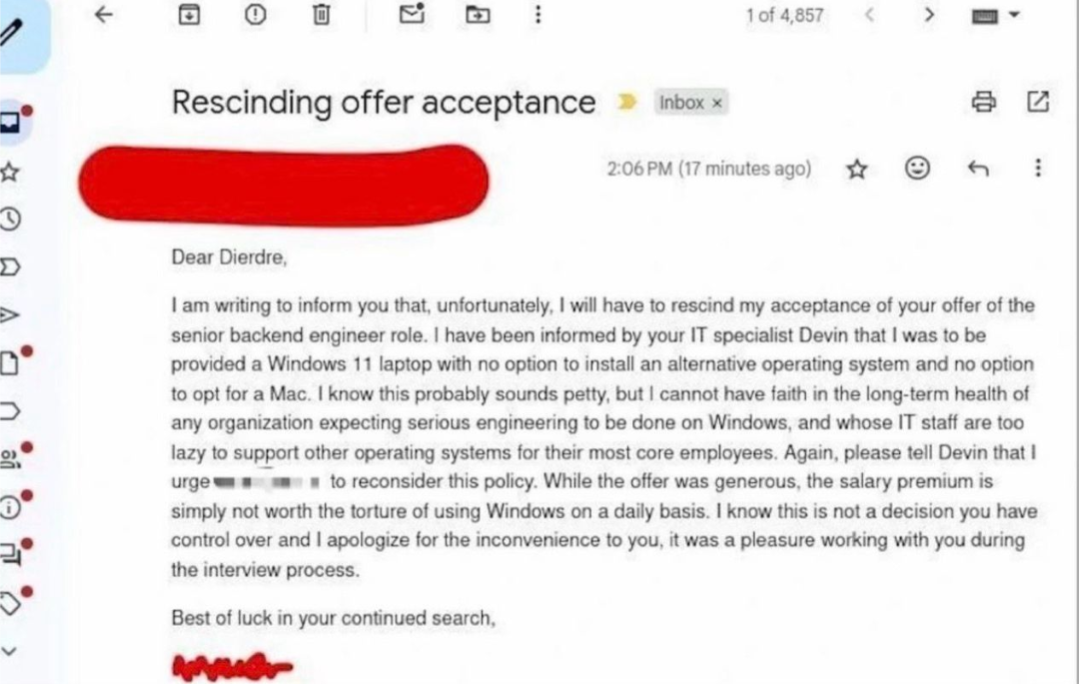
Communicating with IT is absolutely part of the onboarding process. And the phrasing of the email clearly states they are rescinding an offer acceptance, as in they had already accepted and begun onboarding.
You are not considered to be working somewhere until you have signed a contract and after the start date on that contract. Accepting a offer is not signing a contract. You are not working at the new place yet. You have no obligations to do anything at that point. You just need to have stopped working at your current employment before your start date. You definitely do not need to quit before accepting the offer. No where I have worked requires that.
I didn’t say you had to quit before accepting the offer. I said that the onboarding process itself is considered part of employment. If you’re talking to IT about setting up your workstation and not getting paid for it I feel bad that you’re being taken advantage of
Is this some usa user who haven’t heard about other countries? (and I doubt it’s even true in the usa).
Not only is this definitely true in the US but I know it’s true in other countries like the UK and Japan as well.
Dawg put down the crack pipe you’re the only one who is asserting this.
Definitely NOT true in US, or UK. Didn’t work IT when I was in Japan so can’t say for that one, but likely not true there either.
EDIT: In the US this is covered by the Fair Labor Standards Act, which is extremely simple when defining what is considered on-the-job work. If it is mandatory, work-related, and for the benefit of the company, then it is on-the-job work and you should be paid for the time. So congratulations; you’ve likely participated in wage theft by onboarding people who aren’t being paid for their time. Obviously it wasn’t knowingly or with intent, but that doesn’t change the fact that, based on your response, your employers have had you or your coworkers participate in failing to pay people what they are owed.
Except for the other reply that starts “you are right. you cannot onboard a new job before you leave your old one”??? They may go on to say that accepting an offer isn’t onboarding but since I never tried to argue that it was, that’s kind of irrelevant.
Lots of people don’t know their rights or their obligations. Wage theft is the #1 from of theft in the US by a lot. Coordinating with an IT department for onboarding without getting paid for it is straight up wage theft and being taken advantage of. Doing so while still employed by another company is moonlighting under most contracts.
People do shit like that all the time. Doesn’t make it right. Doesn’t make it safe.
If you begin the onboarding process as a senior backend engineer without inquiring as to what your working environment will be, then you’re just incompetent.
If you’re talking to the IT department about workstation configuration without signing a contract and getting paid for it, you’re being taken advantage of.
Yes, it’s reasonable, and smart, to ask people during the interview process about their tech stack. But there is no way I’m coordinating with IT on the setup and configuration of my workstation without a contract in place or before my start date.
Senior backend engineering definitely doesn’t see 99% windows adoption rate.
deleted by creator
Yeah but a senior engineer would just use an old personal linux laptop from home, they wouldn’t even bother bitching about the employer issued machine.
How are they going to use a personal device when corporate policy locks that down?
They don’t use a personal laptop, and I’ve never heard of such thing for any company that has more than 10 employees. The security risk is huge
Clients will have intellectual rights on anything produced for them. Removal of that data from their systems and storing it elsewhere will be a violation.
Using your own equipment other than maybe your monitor, mouse, or keyboard will be a no go. I don’t know of any serious workplace that would let you do otherwise.
Even if you are a self employed contractor you will need to remote in to their virtual environment and work in that.
Okay so remote in then idk how you accept a job and them giving you a windows laptop is a deal breaker
Never, ever, EVER use your personal equipment for work.
There are a ton of legal reasons for that, not just around who owns the Copyright of work done on that machine as well as licensing of the software running in it (most commercial software has different licensing conditions for personal and commercial use) but also because if there’s some kind of legal case against that company your equipment might very well be confiscated as part of an investigation.
Also, more in general, if you have personal practices which are legally dubious or often frowned upon (piracy, porn) you don’t do it in the same machine where you’re doing your professional work, definitelly not on a work machine but even in your own machine it’s risky (see the point above about how your machine might end up confiscated and examined by the authorities if the company is investigated). The principle of “you don’t shit were you eat” applies here.
Even for your own company, it’s best to have the company stuff separate from personal stuff.
Beyond that, it’s also a very good idea in terms of having a good work-life balance to separate the personal from the professional: ideally you keep a very strong separation between work and not-work, at all levels, from work time and outside-work time to work/personal machine and work/personal phone - it helps make clear both for yourself and, even more importantly, others, that there is no work outside work, which reduces the chances of management doing things like call you on weekends or evenings with questions and makes it easier for them to accept when they try it and you say “I’m not at work now, so I’ll pick this up first thing when I’m back at work” - the cleaner and harder the split the less room there is for the “barely in control, almost 100% reactive” kind of manager to sneak work stuff into your personal-time.
I mean yeah i wiped an old laptop and have that as a backup for work, don’t use it for anything else except when i don’t have the work laptop on me
I haven’t found a company that enforces windows of everyone. Seems ridiculous. I would sign the contract then simply require a Mac because I don’t know how to use Windows. IT be dammed.
Smaller companies, maybe. But bigger companies will have a ‘Security and Compliance’ department which will force everyone to use a company-supported platform. It goes beyond OS too. Unapproved apps, even if you are allowed to install them, may not connect to company resources.
Managing centralized security and device management correctly on multiple OSes must be a nightmare. From EDRs to app and device provisioning.
You should do dev work in devcontainers anyway.
Not that it’s an excuse or that I’m happy with that, but I can totally understand why companies do that, and tbh I’d rather see a properly secured than have the option to run Linux.
But I’m biased, because I used to do Red Teamings, and the things I’ve seen…
You should do dev work in devcontainers anyway.
Devcontainers work for Visual Studio Code when developers are more than happy to click their way through running builds and debugging problems. But, as someone whose workflow is optimized for the command-line, they can fuck off.
for a senior engineer position though? That seems counterproductive. I would expect it of one of the entry levels or non-it but forcing a windows ecosystem on a development or engineering sector screams red flag to me.
A senior engineer obviously needs (and knows how to handle) considerably more access to their workstation and company IT infrastructure than the average employee. On the other hand, I’ve occasionally read complaints from IT security types about engineers being way too eager to install sketchy stuff.
There’s some truth to those complaints. I might need to try out several libraries and tools to see what works best for a certain use case. Is that new one with 15 stars on Github actually safe? Are all of its dependencies? How many developers perform a task like that in a sandbox? How many of those perform a thorough audit before taking it out of the sandbox?
Yeah but MacOS has all the same security and group policy controls as windows.
Yeah but managing it fucking sucks.
I recently quit a company that does. They hid that until after I accepted and started. I quit out of frustration after a couple weeks of having to listen the the fan all day due to their surveillance and telemetry running. They even disabled sleep mode, so you either had to leave that thing phoning home 24/7, or forcibly shut down every day. 10 minute boot time on a brand new laptop.
Can you explain this disabling sleep mode thing? What does having the thing awake while it’s closed even accomplish?
Clamshell mode. External monitor, lid closed. My issue was that I could not tell it to sleep when not in use, because their IT disabled sleep to ensure their corporate spyware was always running.
That’s the part I get, but what does having the corporate spyware running 24/7 accomplish? What kind of telemetry would they even get out of that other than ip/location, which isn’t all that interesting.
I have no idea. I didn’t even trust it on my main home network. Connected it to my guest network so it couldn’t scan my home network. Which it tried to do, if course.
It can check if people are typing or using the mouse.
It’s also possible to use the camera of a notebook to track if a person is present and looking at the screen or not.
Any company using that shit is the kind that uses “bums of seats” rather than actual deliverables as a measure of performance, which means they’re also the kind of place were unpaid overtime is the norm and, if in dev, things like projects often ending up in a death march stage - such places are stupidly inneficient and badly managed with a disfunctional work culture.
Avoid such companies like the plague - you’ll be luck if the worst that happens is insane work hours.
I will just throw a fit and they will have to do what I want.
Nah, dogg, nah.
Does anyone actually believe this post??? Because it reads like upvote farming.
Its posted in a humor sub soooo no
Not IT, but my dad said they lost a chemical engineering hire over this once, like 25 years ago.
We had a new joiner quit on his first day because of this. Didn’t even get to eat the burrito he ordered :( So it definitely happens.
To be fair they tried posting it on the Linux community on .ml and there were so many upvotes and positive feedback that it crashed the server. So they had to post it again somewhere more balanced to limit the impact.
Wait a minute, you’re telling me a post on programming_humor might be a meme?!?!?!?
Memes are fine.
But this is straight up propaganda trying to disguise itself as a joke.
If I’d even encounter a dev like the one from the post. I’d laugh in his face and wish him good luck on finding a job that caters to their niche needs.
Meanwhile, I’d be “welcome to the team, you’d do fine here”.
Don’t get the white-knighting for Windows of all things. If you need Windows, ok, but that doesn’t mean everyone needs windows.
Im pretty sure the entire joke is he’s an obnoxious Linux user who will never get a real job and knows absolutely nothing about actual development work
The employer? Albert Einstein.
Not really. My employer provides win11 too, but I do over 60% of my job on debian machines running in hyper-v. (the other 40% are administrative tasks and work restricted environments)
https://en.wikipedia.org/wiki/Empathy_in_autistic_people
Different people are different. For example, maybe ironically, your response also feels like it could be upvote farming to me. Also, the increased sense of justice thing is a thing.
They say while using gmail.
Gmail is functional at what it sets out to do, which is send and receive email.
The sender is not expressing privacy concerns, they’re expressing functionality / utility concerns.
Fair enough, still seems silly as hell to me. Windows is perfectly functional for corporate, and even software development use as long as the team managing the image and standard settings at your workplace is competent.
Yeah, being able to customize everything to meet your preferred workflow etc with Linux is preferable.
It is more than functional for corporate, seeing how the majority of companies run entirely on it.
Gmail is functional at what it sets out to do
it is not. it can’t even do such simple thing as sorting the inbox by the sender’s name. it may seem functional to people who never used real mail client and were brainwashed into accepting this as the only available ui, but it is really not.
It’s tagged “Inbox”, it looks like this is the recruiter’s POV.
I still use gmail as my spam catcher/throwaway account
I use it at my “catch other people’s emails” account, tho so far I haven’t been quick enough on the draw to do cool stuff like slurping account creation tokens, goodie delivieries or stuff like that.
Odd to use it as part of job hunting though, which is the context in this image.
not really… when job hunting most people have to spam the world with CVs and nowadays that also includes registering in a ton of shitty services so you can post your resume or get contact info… once hired, you would use the company’s email so whatever you provided first is usually irrelevant
And preferring yet another proprietary OS.
Better than outlook, no?
Sure, but kind of silly for someone who would take a stand against MS to the point of refusing a job to be happy with Google.
Then again, they also expressed they’d be happy with Apple/Mac
Their basis seems to not be corporate actions, but the usability of software.
They would probably have been happy with Windows 7.
deleted by creator
I think that’s a tad excessive. Sure, Windows sucks, but it’s not my machine so I don’t give a shit. Now, if they expected me to bring my own machine and also insist that it’s Windows, I’ll get pissed off and refuse the offer. Their machine though? They can demand whatever they want, so long as I can actually do my job.
9/10 times it’s not Windows I’m fighting against when I’m unable to do my job, it’s the IT department not giving me admin rights over the right folders so I can’t even install Docker without spending 3 days with them to get the right permissions.
Personally I also would not quit/back out just from that, but “it’s not my machine” misses the point, IMO. It’s a device I’m expected to use ~40 hours a week. Windows fucking sucks. Using that trash for half of my waking hours sucks. Been there, done that, I hope to hell I never have to again.
The fuck are you doing in it?
I’m a software engineer and we use windows. 90% of my day is spent in Visual Studio Professional. The rest is split between chrome, outlook, teams, postman, and SQL server management studio.
I literally never go to the start menu. I have shortcut icons on the bar for everything I need.
In my experience with windows there’s just a slight lagginess everywhere. I’ve had full gaming PCs still feel laggy just in Vscode. It’s not bad but it’s a small pain point that I don’t want to experience for 40 hours a week.
I’m was working on software that doesn’t exclusively target windows. Windows is only a decent dev environment if you’re targeting nothing but Windows. Any other kind of development is a worse, potentially way worse experience than it is on Linux. Using docker on Windows is painful. Using git is painful. Using bash is painful. The list goes on forever.
Most of our code lives on Linux servers. We target web browser most of the time. For those where it’s a windows application then sure it lives in windows environment.
You’re being paid to use the trash though
That doesn’t make it not suck. I’d much rather not hate my job.
I think that depends a lot on what you’re expected to do. I’d write an email like this if I were expected to be an effective developer on a Windows system. I use Linux because I use vim, not the other way around. I can’t WSL for linux to use tmux or something and be nailed to one laptop screen, it just isn’t worth it. Besides the whacky clipboard problems, it’s just not sustainable to be permanently containerized in your host system IMO.
Now if you are using an "I"DE like vscode or something it’s maybe not so bad because it at least plays on windows. Gvim is trash, and the whole reason to really lean in to vim/nvim is to sew your development environment right to any other program you need.
IDK, there’s a dollar value beyond which I would not care, but it’s a gross amount.
Found the guy who wrote the email.
Nah, I got a gig that lets me work how I want within reason. I’m just sympathetically neurotic.
deleted by creator
Windows 11 has been a nightmare for me. Every time I leave the file browser open my fans start up like I’m doing something insensive. Mssms freezes constantly, visual studio freezes constantly. Switching between virtual desktops? Not without waiting 30 seconds. And finally, idk if this is a dell thing or a win11 thing but the “low power mode” that activates if my battery is at or below 10 percent, despite me turning off all battery saving settings I can find, makes my computer functionally useless. Programs don’t load, I can’t close or open anything. Like the whole point of low power mode is so you have a little more time to wrap up things before you can get to a charger. There’s no point to that if you set my PC so low power that it literally can’t even run the bloated ass OS on it. I hate it so fucking much.
I was part of a 4 person IT team managing the company’s Linux servers and infrastructure. I was given a Windows 8 laptop from CostCo. The other admins had Windows laptops but EVERYONE else had Mac laptops. I was the only Mac-centric admin so the engineers came to me for help but mostly I kept their servers running using MobaTek’s terminal app. I used the browser and mail client on the laptop but that’s was the extent of my win8 usage. Which I could have run the configuration management tool we ran (puppet). Jenkins and git were running on the Linux boxes. I had to fix the CEO’s admin’s PC 4 times to remove malware but the engineers and their macs were problem free except for bad keyboards which Apple fixed.
Fully agree. The company also has stuff they have to deal with like compliance, fleet management, device trust etc that I admit is easier to comply with if you just say fuck it windows it is.
As long as I get local admin and WSL. If not I’d probably quit too
If they trust me to manage company and other companies server infra but not to manage my fucking laptop, they can get fucked.
I have to use Windows 11 on my work laptop. So I just put it in its own DMZ and don’t worry too much about it.
Windows isn’t fit for software development unless you’re doing Windows specific stuff. Maybe you can get by with WSL or cygwyn or similar, but that’s just a bandaid to make the machine less windows. You’ll probably still have problems with like case folding and line endings.
As someone who does dev stuff on both windows and Linux, line endings have never been an issue. Are you using notepad or something?
I’ve only had to use wsl for some stuff only designed for *nix, like openresty (and lua in general).
One of the other guys is on Windows and we had to change a config in git to handle it. Not sure what he did on his end. I have vscode on a Mac. Some people at this place have been working since like the 90s and probably are using notepad.
Man, imagine being in a financial situation where you could afford to turn down a job just because of if the OS you’d be using
Why would you not be very clear about this right at the start of the interview process so you’re not wasting everybody’s (including your own) time? If this is one of your absolute show-stoppers, then say so up front and we can either work with IT to get you what you want, or decline and move on to the next candidate.
You have a lot more negotiating power once they give you an offer because of the sunk cost.
They didn’t even attempt to negotiate. They rescinded their acceptance as soon as “IT specialist” told them they only officially support Windows.
That happened to me prior, and I actually told them “hey, I really want this position, but you can’t expect me to do it properly on the same hardware/software you give the data entry employees.”
They gave me a budget to buy whatever hardware I want and told me I can install anything I want but I cannot reach you the sysadmin for any support outside of roles/permissions.
They didn’t even attempt to negotiate.
you’re seeing a snapshot of an entire interaction between multiple people. you can’t be sure there was zero negotiations.
besides, you can’t even be sure any of this is even real.
keep your unfettered outrage bottled up for something else, because this ain’t the one for you.
Yeah seems like it could be ragebait.
I’m commenting on the context given, I don’t intend to waste energy seeking more context on this story…
Are you talking to the employer or the applicant, because it works both ways?
Fair point, and taken. Interviews are a two-way street: the candidate should ask about everything that matters to them, and the company should ask about everything important they want.
To avoid situations like this, it’s best not to assume anything unless you ask first. Windows is the de facto standard in business, yes, but not everywhere and not in every industry.
If your work OS matters to you enough that you will pass on the job if you can’t pick, then you should ask. I would not want to hire someone who will be miserable in the job. And as a middle manager I probably don’t have enough pull to make an exception just for this guy anyway.
Rock stars play by their own rules and they will get whatever they ask for. For the rest of us, we just have to take what we’re issued.
Windows is the PC operating system used by almost every organization. If you aren’t willing to work with it, you really need to be clear about that up front.
It’s like trying to get a job as a mechanic at an auto shop and telling them after the interview you refuse to work on Toyotas.
This is clearly in a field where that’s not true
“I only work on carbureted engines.”
I’ve worked in all sizes of companies, in various industries and 3 different European countries.
In my experience it very much depends on the industry the company in, the division one is working in and the size of the company.
Engineering types in an Engineering/Tech company using Linux isn’t at all unusual in smaller and mid-sized companies. Sales types or accounting, definitelly are using Window. Creatives tend to use Macs, mainly because the Adobe suite runs perfectly in it and the hardware is superior to PC hardware - designer types almost literally salivate at things like 4K monitors.
Real startups (so, not mature Tech companies that try and still be startups) will definitelly have their devs running whatever they want, whist for example big financial institutions will have everybody on Windows, except perhaps top-level management if they’re quirky and prefer Mac for some reason or other.
Then to this add that the kind of professional who not only prefers Linux but can actually say “bye, bye” if they don’t get it is almost certainly be a pretty senior Techie (say, a Senior Designer Developer) and even now those are pretty hard to find for a permanent employment position (you can’t replace those with AI or outsourcing, not even close, and in the path to such seniority many devs who keep on progressing eventually step into management instead of staying on the Technical career track) - outside a large company (were the hiring manager doesn’t have the pull to make it happen), it a pretty good idea to let them use whatever OS they want in their work machine, even if it has to be with the proviso that they won’t be getting any support for it from the IT Support group (which, trust me, they will be fine with).
If a hiring manager has the pull for it and there are no regulatory reasons to make it be otherwise, it’s pretty dumb not to let a rare resource like a really senior dev use whatever the fuck they want on their work PC if that’s going to allow you hire/keep that person.
In my company, everybody is on Linux and if you want a Mac you need to make your case. 0 Windows laptop.
Your company is an outlier.
Yes. Doesn’t mean they don’t exist. Everybody is complaining about AI, Windows, whatever and nobody accepts to work for a smaller company because you earn less.
Either take the money and stfu or take the loss and work where your heart is.
Nobody said outliers don’t exist.
What we are saying is that the majority (like 80% or something) are run entirely on Windows. No matter what the Linux fanboys want to believe.
And I’m not denying any of this.
refuse to work on Toyotas.
Nah, the analogy that would be closer would be if the shop said you must use some overpriced but notoriously fragile tools and you’ll be on the hook for any tool that breaks and any delay you incur will be your fault while they go buy a new tool. Plus the tools tend to have sharp edges on the handles for some reason and are just painful to use.
Now if the job is “you need to administrate the group policy of the company systems”, then “I refuse to run Windows” is a pretty stupid take. But frequently the job is rooted entirely in Linux based infrastructure for internet facing stuff, and Windows on the entry point is just horribly awkward for that job. You can kind of/sort of get there but I haven’t found a single decent ‘Terminal’ even compared to that being pretty trivial with Mac and Linux. WSL starts to provide something useful, but it is kind of fragile and WSLg sucks with the worst window management possible, even by the standards of Windows broadly. Meanwhile, starting from a Linux system you can use a desktop shell that is probably better for your productivity than anything Windows allows.
There’s not really a whole lot of logic for a lot of “Windows required” jobs in tech. Office365 is mostly fine through a Linux browser. Onedrive works with Linux. If you have some applications that are Windows only, again, sure, but a lot of tech folks don’t need any Windows only tools.
Recent example from my real world, someone was around my desk and asking questions about stuff that required me to hop between a few contexts. They were shocked how quickly I could navigate a bunch of the windows in the discussion, and asked how in the world I got Windows to do that. Of course, I couldn’t.
Besides, the general tone of the conversation could have been just full of redflags about how tortuous the company was going to be. One company blocked SSH between anything saying SSH was insecure, and said that, somehow, we had to do everything through the graphical console of the Linux instances. Which meant no rsync, no scp, having to create some file serving facility to upload files to and then download from. If my daily workflow depended on such draconian crap, I’d be out of there too.
Dude how many qualifications do you have that you can turn down a job offer in this economy over such a rather minor inconvenience?!
Dude, that’s like hiring a truck driver and telling him his lorry will be pulled by 4 horses.
If they want to pay me to deliver stuff on a unicycle, I’ll be delivering stuff on a unicycle. Do I want to ride a unicycle? Depends on the pay.
It is a mistake to see oneself as a mercenary in this way. We should all be the happier if objectionable jobs were harder to staff.
Sure, but it’s difficult to classify which jobs are objectionable and what the price should be for someone to do them anyway.
As someone who rides a unicycle professionally: what type of unicycle? Is the company specifying a particular brand because I only ride Nimbus.
I’m afraid you’re overqualified. It’s an entry-level job.
Perhaps someone with higher standards like you would be a better fit for our penny-farthing department.
Your chariot awaits! It’s an actual chariot
Yet I work for a very successfully (we have too much work and don’t even advertise for it) small company and we all use windows computers as software engineers. We use C# .Net Entity Framework, SQL, GraphQL, React Typescript or WinForms.
We have some large clients that most people ok earth have heard of.
Nobody thinks you can’t do software engineering on windows. It’s just worse.
It really isn’t though. I’ve done in on Windows, Mac, and Linux.
Mac and Linux are easier to install stuff but on the whole the experience has been almost identical.
You’ve used modern Linux and modern Windows and think the experience is almost identical? That’s an uncommon opinion.
That’s an uncommon opinion here. Here being the operative word.
Look in I’m not going to say I wasn’t disappointed that it wasn’t Mac which I used at my last job, but when it comes down to what we need to do in a day I don’t notice the difference.
I tried Linux last year as a daily driver and gave up as I’m not looking for something else to debug in my own time. I now just want it to work.
I’ve been using Linux and MacOS my entire life, with brief stints on windows when my job has required it. Every time I have to use Windows I’m gobsmacked at some of the design choices, bugs, lag, and anti-patterns.
You’re absolutely right that it’s mostly the same, you mostly use the same apps, you still use a mouse to interact with them, there’s still a file system, etc. But when the experience is mostly the same it just makes the parts where they differ so much more frustrating in my experience.
Unfortunately my experiences trying to use Windows as a daily driver have been much like yours with Linux, I find myself messing around with stupid bullshit in a never ending cascade of settings menus, each more janky than the last, just trying to do simple things. It’s unfortunate Windows has become so janky as I remember it working quite well back in the xp days.
All this is to say, I think at this point Linux is often as good as Windows (it does depend on the distro, tons of bad ones out there), but familiarity is king. I’ve spent decades using all three operating systems, and have mainlined Linux since 2023, so that’s just what I’m most familiar with now.
I’ve lost track of what we were originally talking about, but yeah. They’re all good enough just use whatever you’re comfortable with and don’t overthink it I guess 🤷
What exactly are we talking about? Doing Windows related development on Windows is roughly as decent as doing Linux related development is on Linux (or Mac).
It’s just that because like 90% of servers are Linux, 90% of development benefits far more from being developed on a Linux-y system.
For example, the Windows filesystem is very different. Over and over I’ve had issues with permissions being different, with paths being inconsistent (this happens esp. with WSL) and with limits on path length.
You can develop on Windows, but having the test env closer to the real env takes care of so many little headaches.
Have you considered that you might have too much work simply because these tools are inefficient?
Eh C# GUI development is quite productive. I don’t think you’d get such a pleasant experience on Linux.
C# development is incredibly efficient to be fair.
Have you considered not asking questions based on conjecture? No it isn’t because we are inefficient. It’s a mix of staff come first and the work comes second and a lack of greed I’d say. Most of our work comes from word of mouth and we keep client for as long as they’ll stay with us.
If a client reads a spec and get the application described and decides it’s not right we will change it for them for free to build a relationship. Which is why we get more and more requests to work with us.
As someone who has worked with a pretty large C# codebase and several smaller ones, I’ve found it to be one of the least efficient languages to program in. This is maybe not a technical fault of the language, but the way Microsoft encourages developing C# means that once you get past a certain point even simple MRs will have 10-20 files changed. There is sooooooooo much boilerplate caused by .NET that even things like Java Spring Boot just don’t have (and even then I’d consider Java to be a pretty bloated language in terms of boilerplate).
That’s ignoring the fact that the ecosystem surrounding .NET is a lot more enterprise-y, meaning a good portion of libraries require paid licenses to use.
Yeah, I totally get where you’re coming from. I think it depends on what you mean by ‘efficient.’ If we’re talking about runtime performance and memory management, C# and .NET are generally very efficient: JIT compilation, span/memory optimisations, and the garbage collector all make it competitive with Java in most workloads.
Where I agree with you is in developer efficiency: .NET projects can definitely get heavy with boilerplate, especially in enterprise setups with lots of layers, dependency injection, and config-heavy patterns. That’s not necessarily a language issue, but more a combination of the framework conventions, Microsoft’s enterprise guidance, and patterns like MVC/WebAPI scaffolding.
“Minor” inconvenience is not having a coffee machine in the dining room, it’s nothing like the culture of incompetence that permeates organization that are that severely vendor-locked.
Exactly, it’s a serious red flag.
If you’ve currently got a decent job, then you can afford to be suuuuper picky.
The best time to find a job is when you have a job.
I can say also as a senior engineer, I would never turn down another o ly because of this. It’s not my software I’m making, it’s the company. It’s not my things. If they want me to code on a pentium 3 I’ll happily do it, it’s their money. They want me to waste it on that, that’s on them.
Yea, but some of us would rather choose to enjoy the work. Paycheck and pleasure doing the job is where it’s at.
That isn’t minor at all. If I’m using a tool all day, it needs to be something that I’m comfortable using. Forcing me to use Windows is like taking my office chair and replacing it with a chair that has a lumpy cushion and broken casters.
I understand putting up with a shitty job situation because you need the money, but this is certainly not a “minor inconvenience”.
I find it crazy how many people here are making it sound like it’s torture to use Windows. I get that they prefer Linux, but for many it seems like it goes way beyond normal preference to something that’s a core part of their identiny.
God you must make a ton of money
Lmao mac elitists
I think this person actually wants to run linux, but they are using Mac as a test case.
They mentioned “install an alternative operating system” - which on hardware sold for Windows very much implies Linux.
But if Linux is a no, and even macos is a no - which is from a “big proper company” with support agreements and everything - then the company is obviously a lost cause who are set on windows for life for all time.
Windows is shit for most things. Especially shit for development.
extremely based, I have no idea how any dev at my company tolerates windows.
in addition to how extremely slow and incapable the OS is in general,we have to submit tickets to run software because everything is installed through random .exes.
Lmao.
,we have to submit tickets to run software because everything is installed through random .exes.
You have to do that because your IT department doesn’t trust you. There’s no difference in danger between a dev with system access installing an exe or a DMG.
You have to do that because your IT department doesn’t trust you.
Nor should they.
Install Linux subsystem for Windows and you’re golden.
Hahahahaha! No. WSL is in no way a good substitute for a real Linux system. It’s better than nothing, but that’s about it.
deleted by creator
I had to do that once but the company wanted me to use a Mac over my own Linux. I can’t stand anymore to be forced to use specific platforms to do my job. It’s like going to a car repair and demand the mechanic to change your tire using a plastic wrench.
I mean, it could make a difference if you had to use OS specyfic tools, but if you’re going to just code, use whatever you want.
In a Gmail client 🤮
I dev every workday on Windows 11 and I don’t get why people feel like it’s awful to work on? I dunno what everyone else is doing but it’s basically just switching between the IDE, Slack and the browser. The OS never seems to be an issue for me. My only real gripe is that even I click update and shutdown at the end of the day, it updates and restarts.
Same for my colleagues using a Mac.
I’d be more bothered about using Teams over Slack
You have to install extra crap to get the terminal to work like unix and I always had to fight with it to install things. Not worth the time. Maybe if you don’t need a terminal though?
You install git and you get git bash that works great in the Windows terminal. That’s something you do once. I use the terminal daily, not an issue at all.
Cool, and then there’s NEVER any problems with different paths? With back and forward slashes? With the limit on path length? With missing permissions on the file system requiring weird workarounds?
Most importantly, your server is likely not Windows, yet you test on Windows, and that’s never ever been a serious source of issues?
And don’t say WSL. That’s like saying the fix to using Windows is to use Linux, but fiddlier. Not to mention you still get issues with the mounted file system.
Cool, and then there’s NEVER any problems with different paths? With back and forward slashes? With the limit on path length? With missing permissions on the file system requiring weird workarounds?
Nope. The language we use handles that for us. I don’t think path length has been an issue for a while now?
Most importantly, your server is likely not Windows, yet you test on Windows, and that’s never ever been a serious source of issues?
We use serverless functions using Linux and it’s never an issue. My previous employer, we had Windows servers and Linux based containers, and that wasn’t an issue either.
I never had to do anything on my Mac it just works every time
Also some of the libraries I use aren’t even supported on windows. I know a bunch of node libraries that I had to change in project repos to accommodate engineers using windows specifically. Windows is shit
Also it’s riddled with ads
Enterprise Windows does not get all those ads. I haven’t seen a single ad on any of my Windows machines.
Apple doesn’t sell a Mac version with ads and a version without so that seems better to me too. Why do I have to pay extra for that?
Because you’re already paying more for the hardware with a Mac.
This sounds more like IT babysitting.
If IT cant trust software engineers to have full admin rights on a work computer, either the calibur of your co workers is so bad that no one should want to work there, or the IT department has such a god complex, no one should want to work there.
No IT should trust devs to have full admin rights. Y’all know enough to fuck everything up and then blame IT for not knowing how to fix your weird ass edge case in 30 seconds before crying to the CIO.
It obviously depends on the environment, but if I am supposed to develop tools that, in theory, can fuck up everything, then I also need access to everything (on my machine). There’s no point in testing, if the elevated access rights on the server suddenly surface a fuckton of extra bugs.
Heck, I need admin just for the basics of installing developer tools and opening web ports.
They tried to lock our stuff down once. After a couple of days of absolutely zero work being done because all our tooling was missing, and the poor IT guy had to somehow learn how to install every tool we needed and taking forever, we just got sudo rights.

What ide are you using?
Im in firmware. IDEs change often depending on the chip i am working with. In some cases, the tools are better on windows, or have been in the past. It has gotten alot better recently.
How do you audit your IDEs extensions?
Or you could just use a cross platform terminal such as Powershell? I also use Terminal to have nice UX.
Teams has recently decided to stop working on any browser except edge. I don’t know if this is intentional (at least chromium should work similarly) or if it’s a wayland thing, but I’m just assuming malice since webrtc works fine in all other instances.
Fuck all of microslop on principle.
I use teams in Vivaldi with wayland. No problems beyond standard teams jank.
That doesn’t seem to be a generic issue, I am still running Teams through Firefox as a PWA on Ubuntu.
I’m usually on LibreWolf, but I tried FF, Chromium, everything in an X session, no luck.
I use it in Firefox. I think I had to make some cookie exceptions or something like that to make it work, but it’s functional. Still buggy, but Teams has always been buggy for me no matter the platform.
Windows can add some complications as a dev, especially in the corporate environment when really strict group policies are implemented that stop Devs from installing or configuring systems as they need.
One company I worked at remained on Windows LTSC for security reasons, and a lot of Devs that were working with Java hit a snag if for whatever reason an IDE they were using really wanted a system environment variable configured a certain way and it would straight up ignore user environment variables. They would be restricted from basically being able to configure anything without getting IT to remote on and make the changes for them.
I was forced to use a Mac for the first time years ago for work, I still hate working on a Mac but I can’t deny how much more flexible it can be compared to working in a Windows environment that is locked down.
This isnt a windows issue, its a company policy issue. If developers dont have full admin rights on their systems, its a failure of managment. If you cant trust your developers enough to give them admin rights, thats not a co worker i want to be around.
It’s slow, it’s unstable, it’s slow, it’s hard to customise, it’s slow, it’s bloated, it’s slow, it’s counter intuitive. Did I also mention that it’s slow?
Personally I’ve never experienced any performance issues with it, seems fast and responsive to me.
Same here. I primarily use WSL2 as my dev environment. Everything outside that is native apps for collab and tooling.
Sure, if you just use Linux for dev, with a Windows hypervisor, you won’t notice the difference.
We devs also have a serious issue of performance blindness, because generally work and test on pretty beefy machines. Windows 11 is undeniably heavier on the system than Linux, and Mac hardware flies anyway. If your dev machine is beefy enough, you won’t really notice though.
Yeah I always have high end systems.
I dont disagree that windows sucks. I just don’t see it as a major issue for doing dev. As you say, that’s correlated to my high end system
I think a lot of it comes down to the build team.
We have a very strict build, and while there is bloatware I could do without, they’ve always been great about handing out new machines, so we generally stay ahead of it.
The issue I run into is that at our company, I’m very much “That guy”, who needs all the exceptions and special software.
While they’ve created some AD groups for me that provide most of what I need, transferring to a new laptop is a major procedure as I never know what new restrictions have been put in place that I’ll need exceptions for. It’s a constant battle between security and having the tools I need to do the job. I always have at least three laptops, one that I’m using, one I’m working on setting up, and the old one I can’t let go of.
All that being said, yes, win 11 is an absolute pig compared to other options, once my machine is dialed in, I really don’t mind the environment.
Course, it helps that my lab shares space with the end user IT support team, so all I have to do is call over my shoulder to have something fixed.
I always have at least three laptops, one that I’m using, one I’m working on setting up, and the old one I can’t let go of.
You sound like you need some VMs. Particularly for whatever is on that old laptop.
Have been working on moving what I can to a VM, but the systems I develop require physical access, and when I’ve asked, I’ve been told there is no way to give a VM access to the laptops ports.
Many of the systems / devices are on physically isolated networks, use RS-232 or USB for access, etc.
If there are netsec approved ways of passing physical ports to the VM that would solve a ton of my issues.
God damn powershell. I use my terminal daily! More than daily even! I love my posix compliance and my gnu utilities! I like it when env vars, such as path, take effect without having to restart the top of tree process again. I like that my OS UI isn’t a react native app. I like that my laptop has a longer battery life. I like that sleep works reliably on my machine. I like that I can manage my packages and apps through a package manager (yes, I know you can now do it with winget). I like that I have control over what updates in my system and when and how I am affected. I like that I can use the multiple desktop/spaces features in a nice way and it is not finicky (Mac and Gnome do this particularly well). I like that my system search actually works well. I like that my system doesn’t show me ads when I try to use features of it. I like that when I change defaults on my system, I don’t get reminded to use something else than what I choose. I like that my defaults don’t reset after an update. I like that I can trust my os and that it doesn’t collect all possible data about me. I like that I have the ability to turn features off entirely and avoid them easily, and that those features aren’t straight up spyware.
I never use Powershell and I use the terminal daily.
It very much depends on what you’re developing for.
Back when I did server-side development (which almost invariably is targetting Linux servers), having Linux as my dev environment was much better if only because I could run parts (or even all) of our server code directly in my machine configured as a Dev Environment.
However, for example, for Game Dev running Linux is much more of a problem because some tools are for Windows and you have to jump through hoops to make it run in Linux, if at all.
If you’re doing development on internal frontend systems for use by the Business side of a non-Tech company, then Windows is almost certainly the best dev OS because the software is meant to run in Windows machines (as that’s what the Business runs, unless we’re talking about creative companies, in which case it will be Mac) so the very same reasons why Linux is better for server dev apply here for Windows - it way more straightforward to develop in a machine where you can directly test at least parts of the code within the OS it will be running in.
Yeah, you can run virtual machines or deploy to a dev server, but that just adds extra steps and hence extra overhead for frequently done things like running small snippets of code whilst developing just to check it’s working as expected.
Then there’s the whole big company vs small company side of things: big companies have dedicated IT Support people and those will naturally try to standardize things for the obvious reason that it’s way more effective (same thing in dev, by the way, good Technical Architects try to keep the number of programming languages used low because its generally more efficient to have libraries, frameworks, maintenance and hiring practices around a smaller number of languages than it is to do it for many languages) which in turn means that in large companies “everybody gets the same” is an almost unassailable policy except for top-level management.
Honestly, yeah, I’d do the same. After several past jobs required Linux, even downgrading to a Mac feels pretty bad. Can’t imagine Macroslop Wangblows.