

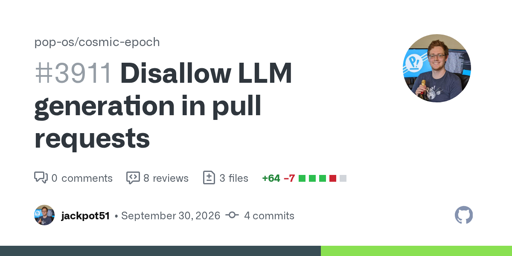
Fingers crossed Gnome follows suit! :)
I don’t get the hate Cosmic gets. The only mistake they made is that they released the first non-testing version of their new DE too soon.
Cosmic is the only full DE with usable tiling out of the box & tiling is superior, full stop. If I had to use a DE again I would probably use Cosmic. Even if we ignore tiling & focus on the floating experience, even today it’s better than Gnome without extensions, it’s not even close.
The Linux community has an oddly selective memory. Everyone remembers when Ubuntu had Amazon’s crap preinstalled, but now that Plasma 6.x is actually good everyone is conveniently forgetting how incredibly bad KDE 5 had been for most of its run, like so bad that it’s hard to put it into words. Cosmic is much better than Plasma 5.x & it’s getting better.
(though I do think excluding the use of Ai tools in a climate where all web browsers & operating systems are accepting LLM contributions is a wee bit strange & largely political)
They just released an OLED laptop and cosmic has no sign of supporting HDR yet. They are so far behind, its kinda hard to see what they were trying to achieve. I wanted to like their stuff, but the hardware was really subpar for the price. To top that off, they don’t “support” linux, they just ship it. I think they should mainline their drivers but I don’t know a ton about kernel stuff 🤷♂️. Either way the result is they only support pop and Ubuntu which was disappointing.
Hey Claude, please write “I have not used any LLM content in the creation of this patch” on all your commits.
Even if you don’t disclose it it’s immediately obvious to anyone with a brain that you haven’t worked at all on it.
Honestly, there are a few thoughts about this (and yes, some will be unpopular what I say).
- There is the ethics problem of how LLM is trained. It is a theft machine. Thats why companies love it, because they can steal work and profit
- However, people WRONGLY assume AI is exclusively for Vibe coding. When used by Senior/real developers, it is super useful for writing tests and code reviews. Some of the issues I’ve found in our old code from 10 years ago, were never reported (or, we had reports, but always assumed it was something else). There are tools for code review (and have been for a long time), but AI has stepped it up. In well designed / stricter languages, you can avoid a lot of errors that AI is good at detecting, but, it is still super valuable for this stuff.
- Also, good for security testing too.
- The biggest issue are untrained slop cryptobros, who throw money at it, and can’t test (or understand) their code. Then it wastes other devs time reviewing it and identifying the 50 regressions it causes.
- We’ve had cases where I’ve had to argue with customers that Claude is telling them bullshit. From the support side, it has made things WORSE.
I’d argue it isn’t actually a good thing necessarily to ban using it as a tool entirely from senior devs.
The biggest issue at the moment are arrogant junior cryptobros who are too lazy to learn to code, and just want to throw money at the issue. And that wastes everyone’s time.
What we really need is a ethical AI model that only uses completely open code, pays people for their code (instead of just stealing it). and a way to ensure it is only used by developers who can use it properly. Ideally, only allow that code to be used for open source too
I actually wouldn’t want to see Gnome/System76 completely ban it. What I would want to see is for it to be permitted for approved devs with VERY specific guidelines dictating how it can be used.
It can actually do everything you mention, and under a watchful eye, generate reasonable code to spec. If you give it the architecture and requirements, it will make it as you see fit and generally faster than a skilled human.
But even beyond the theft, the resources required to do this are insane. The power and hardware needs are off the chart, and we’re still paying for all this with Monopoly venture bucks.
The issue for now is LLM generation of code, not code auditing.
And no, I don’t give a fuck whether some genius in theory could paint s new Mona Lisa with it. The issue us how it is used in practice, most of the time, today. At $WORK, I have a severely ai-pilled Senior Embedded Software Architect which hasnt managed in one and a half year to set up a working driver for a RS232-controlled stepper motor, from a port of previously working code. A thing that should take a week at most. I had to educate him that in C++ drivers, you need to use locks or mutexes to access variables that are concurrently changed and read from several threads. AI enables catastrophic levels of incompetence.
And FOSS projects need to protect themselves against that.
Yeah… LLM Generation I agree is the biggest issue by far.
On the Kernel side, code review though apparently has been a big factor apparently, because people are testing kernel modules in seriously dumb tests that would never happen in practice, and then submitting some of the dumbest patches to protect against faults that won’t happen in reality
As a retired senior programmer, I would have loved to use LLMs in the past for very specific things. I wouldn’t use it every day, but like every couple of months I had to do a massive refactor that took weeks to complete. I usually ended up writing codemod and just painfully changing tens of thousands of lines of code. Would be cool to just say “hey LLM, see how I did this one? Do the same thing everywhere else you find it. If you encounter anything that’s too different from my template just leave it for me to review”
Yeah, and that’s the stuff people don’t talk about
I have used it to do a lot of refactoring too. Vs code has been able to do basic refactoring for a while, but, it is also good for splitting up code into different files as an example (as long as you use a plan, it works well)
But, that’s because it’s also been trained how to do these tasks. And it isn’t really doing much with the code for them
For me it’s the exact extreme opposite than your first point: The LLMs as death of copyright could be an actual food thing.
The issue im struggling with is the ecological and economic harm. It feels a bit as if the steam machine would’ve been invented but you’d throw in babies in addition to coal.
For the plus sides you’re right (as in: I agree so it must be ;) )b- with one minor exception: the vibe coding part is not bad in itself. I actually used vibe coding as a very hard exercise: develop something and find ways to estimate its quality and performance but you are not allowed to look into the code! It’s a fun brain teaser because it forces a pure outcome-perspective. The code itself is irrelevant for this, it’s the mental training that’s really interesting.
Oh except people who publish vibe coded stuff as a cool new project without disclaimer. Or as PRs. Or as … Well anything where do see itself is actually important.
death of copyright could be an actual [g]ood thing
It could. It would assuredly be a boon to the development of de-build chains: decompilers and the like.
But, as long as Disney and Amazon get protections, I’m going to advocate for the protection of works by independent artists and coders, particularly CC-SA, GPL, or AGPL licensed works. This does mean resisting LLMs (and other generative AI) on copyright grounds. (Even if on the other hand I might advocate for the undoing of copyrights generally.)
And, even if that class of issue were settled, I also agree the current state of generative AI is a travesty to be resisted on ecological and labor terms. As just one example of ecological harm, MS undid years of sustainability work in service to Copilot. As one example of harming Workers, Amnesty International has identified human rights abuses in the training of several model brands.
The vibe coding thing IS bad though… The code being stolen isn’t the code generally written by big companies (because that’s in private repos)… It’s also stealing GPL / MIT code too, and not crediting it. And then the vibe coding bros take it, boast they made it, don’t give credit, don’t use it to improve AI, and they sell that code
I’d have no issue if it credited the original projects, but it doesn’t… And thats why nobody can hold them responsible.
The ecological harm is a fair point though. They’re setting up gas plants to run these things, instead of forcing renewables.
Oh the corporate bullshit I’m with you - but I’m opposed to copyright as a mechanism, that’s why I focused on it. Code can’t be “stolen” the same way a movie can’t be stolen in my book. That said:
With the crediting you’re absolutely right, I had not even thought about it and that’s not what I intended to imply. Thank you!
Although I lack the fantasy how this could look like. I’d be very happy if LLMs would be waived the “by” aspect as it’s in possible to link a generation to a dataset - but the training data has to be publicly available under the most generous licence consumed.
But that’s wishful thinking, I know.
i think the copyright question is still unanswered: it could turn out that any LLM-generated code is a copyright violation by definition unless trained exclusively on a clean, legitimately-obtained dataset (which few of the major models are).
Will projects that allow LLM contributions have to roll back years of progress when the other shoe finally drops? Seems like a huge risk, especially for FOSS and copyleft. I think disallowing LLM-written contributions until this is all sorted out in the courts is the pragmatic move from a legal perspective.
If it turns out that it gets ruled as copyright violations, you can bet your ass they’re going to reform copyright law instead of rolling everything back.
I don’t disagree that it is a risk, and I am trying to move toward projects that do have err on the side of avoiding that risk. I have NetBSD on my laptop, and when I get a little more comfortable with it, I intend to convert the other Linux installations I maintain.
BUT, I believe the BSDs already went through a situation where some of their source was possibly under restrictive copyright and rather than “rolling back”, they “simply” identified the possibly infringing code and re-wrote those sections to have the same function (which can’t be copyrighted) without sharing any creative expression (which is). So, even the projects that are taking the risk that an LLM (or other generative AI) generates infringing code might not have quite as much cleanup / lost effort as you describe.
Also, LLM out isn’t automatically a derivative work of the training data. I’d have to dig through some other messages to find an exact quote from their documents, but I believe they (EDIT: the U.S. copyright office) said only output that is “significantly similar” to training data is potentially infringing. That does further limit the risk.
I still think it’s too high of a risk because well-meaning contributors might incorrectly introduce infringing code, since for models that don’t disclose their training data (Claude, Copilot, Gemini, etc.) even dedicated contributors don’t have the information they need to discover the output is infringing. In that past, that result (introducing infringing code) was generally limited to the acts of malicious actors that are submitting code they know to be infringing to poison a project and open it to legal action.
But, I can’t ask that someone (i.e. a project maintainer) substitute my risk/reward judgement for theirs, and I have no experience maintaining a large project. All of my code contributions are to either projects others maintain, or my own hobby projects that I doubt have any users other than myself (and I don’t even use all the published/available ones anymore).
i think the copyright question is still unanswered: it could turn out that any LLM-generated code is a copyright violation by definition unless trained exclusively on a clean, legitimately-obtained dataset (which few of the major models are).
I think this argument is BS, there are several remix/sample based albums that count as derived works and AFAIK, no one is getting paid.
Not exactly the same, and the music industry has had plenty of lawsuits going both ways on that kind of thing establishing a status quo for remixes and samples in music
SilvaGunner 🫡
It’s answered, unless all big tech is going down suddenly, they are allowed, copyright violations are for the poor anyway.
Few? Do you have some example, maybe two?
IBM Granite (EDIT:
and Apertus) do disclose all their training data and claim that all their training data is effectively free of copyright (highly permissively licensed). I have not been able to verify that, due to my lack of skills with the conventions and tools of LLM / Agent training and publishing.So, yeah, probably (EDIT:
twoone).for those who said the deets, thank you!
The Apertus Swiss AI unfortunately doesn’t seem to live up to its claims, and they have been silent on the issue brought up there. I honestly suspect the same of IBM’s Granite, but have not investigated.
Thank you for the link! It does look like Apertus itself might be Free Software (the U.S. copyright office says training can infringe, but is usually fair use), but it can still output derivative works of copyrighted inputs that might prevent them from being distributed as-is (for example, requiring attribution) – at all, much less under a strong copyleft.
Few could be zero lol, i have no idea.
IBM Granite (EDIT:
and Apertus) probably qualify.
I gotta admit KDE’s stance on this frustrates me a lot.
On the flip side… I am also fully aware that policies of prohibition, in the broadest sense, tend to not be terribly successful, and I wouldn’t be shocked if some contributors simply excise the “co-authored by <agent-name>” from the commit messages with a simple pre-push hook or something like that on projects that explicitly prohibit LLM/codegen usage.
IMO one of the major problems with LLm code generation is that it has the capacity to overwhelm human capacity to review code and properly understand the codebase.
From that perspective, a prohibitive policy doesn’t have to be 100% effective to be useful, it just needs to slow things down enough to keep the manageable and maintainable (and fun to work on).
Some people will absolutely lie, but I suspect most contributors will respect the rules, and ultimately cut down on AI PRs overall, as those AI contributors switch to projects who are pro-AI.
There’s no need to excise anything unless you specifically let an agent create a commit. No need for pre-push hooks.
I think KDEs policy is quite rational, it’s a compromise and still clearly anti-vibe coding. IMO the problems are overstated
KDE’s policy proposal explicitly allowed for contributors to not disclose that AI was used, which according to the FSFe and Software Freedom Conservancy, is not a good idea in legal terms.
“FOSS project leaders cannot make good decisions about LLM-gen-AI policy if they cannot survey which contributions were assisted, and how much they are assisted. Part of the contribution process should (at least) include a disclosure of what LLM-gen-AI system was used, its version (as these systems change over time), and a brief description of how the system assisted the contributor. This information should be included in a machine-readable format in commit logs."
Indeed, such disclosure can be an important foundational step to allow for the accurate assessment of the copyrightability of code that has been assisted or generated by AI tools, in order to assess their licensability into Free Software. Open and clear disclosure is a helpful step for the Free Software community to maintain a healthy licensing ecosystem, which is currently threatened by the legal uncertainties that come with the advent of generative AI.
Additionally, it is worthwhile for developers to document in some capacity the extent of human work that they have done in their software projects, whether it be the writing of code, the selection and arrangement of components within the project, or the extent of human modification of machine generated content.
Not to mention the ethical and environmental concerns with corporate AI usage, the use of which KDE was not interested in attempting to curb within its own project, which personally I think was disappointing, and even their KDE Eco group stated the policy was incompatible with the goals of KDE being a green project.
and I wouldn’t be shocked if some contributors simply excise the “co-authored by <agent-name>” from the commit messages
A simple mention of it in your agent instructions will also do it.
Or you tell it not to commit but to suggest the commit message
TIL!
(though personally I don’t consider Elementary’s Pantheon desktop a ‘major’ DE, since it’s only used by 1 other obscure distro besides Elementary according to distrowatch, and AFAIK elementary itself isn’t super popular. Still, cool to know!).
Why not Void Linux? “Stable rolling release” does not sound so bad, considering the current floodvif security vulnerabilities…
Did you mean to have that be a response to a different comment?
Loving my move to Fedora Atomic Cosmic. Happy Silverblue user of long time, Cosmic just fits my personal zen better.
With their fast pace of fixes/new features, this AI stance is just the nice cherry on top.
Did you ever run CachyOS? I’m on it currently and I’ve been considering distro hopping to try an Atomic OS like Fedora Silverblue.
I tried Cosmic cause it looked interesting but had some issues in how game windows loaded so that kinda turned me off. Considering giving
NobaraNoctalia a go.Edit: got my N names mixed up
I’m a Linux noob that started with CachyOS earlier this year to jump to an atomic distro recently. like a month ago give or take. I chose Bazzite though. context, am gamer, my PC is mostly for gaming and entertainment.
idk if I like it though. it’s one thing to learn all the normal Linux things I can do, and sometimes need to do, but to add the atomic / immutable concept layer is a bit discouraging to me.
I’m thinking of going back to a non atomic, but wanting to try fedora based Nobara next
Did fedora make a stand against AI? If so, I might jump from Debian
They have not, they do accept AI contributions, however their policy is a bit more restrictive than Debian’s in that Fedora at least requires contributors to disclose LLM use in pull requests.
There are a few distros that do reject all AI code, which you can find in these two lists:
https://noai.starlightnet.work/list.html
https://codeberg.org/ethical-foss/open-slopware#linux-based (under the ‘Alternative Linux-based operating systems’ section).
Fingers crossed Gnome follows suit! :)
Fingers crossed they wont.
Kernel allows AI though: https://docs.kernel.org/process/coding-assistants.html
Now if only it wasn’t a buggy mess all on its own.
Fluff and buzzwords to keep the fans indoctrinated.
Indoctrinated into a desktop environment? What the hell are you smoking?
What annoys me most is that this whole topic is becoming a political thing, with only two camps. As if we don’t have enough issues already.
As a former software engineer, I understand that there are reasons for and reasons against the use of LLM. I can also see that open source projects can get easily overwhelmed by the amount of garbage that gets produced by non-developers. But does it really have to end in prohibiting technology in a technological project? How much politics should affect technology? And where do we draw the line?
Those are novel problems and it will take time until we figure out how to properly handle them. Looking at the past, prohibitions rarely work without proper enforcements. Usually everybody loses in that case.
There’s some serious concerns with corporate AI that, IMO, make it a no-go under almost any scenario.
Corporate AI Concerns
-
Simply using an AI that’s run on a corporate data centers encourages the construction of yet more data centers, with all of the environmental/climate negatives they bring, as well as local harms they induce on the people living near them, such as increased electricity rates.
-
Using corporate AI directly helps the financial situations of those giant corporations (by boosting usage/user numbers, they are able to attract more investment capital), most of which are ran by right-wing CEOs who are more than willing to collaborate with and fund fascist governments to ensure that they are not regulated in search of both maximum profits. Some of these companies, such as Nvidia, Palantir and Oracle, genuinely appear to be seeking to use these tools for what would previously be considered crackpot conspiracy theory levels of public control and surveillance.
But if we ignore those and instead focus purely on self-hosted AI, we’re still going to run into some roadblocks :\
Unfortunately, there does not currently exist a self-hosted LLM model that wasn’t trained unethically on copyrighted code (the ones that do claim to be ethical have not lived up to that claim).
Realistically, even with an unethically trained local LLM, I don’t think using the available self-hosted LLMs to try to find bugs in some code is terribly unethical or damaging, that’s probably the only use-case I would sign-off on within a FLOSS project. I also don’t think it would matter too much if someone wanted to use a self-hosted AI to code some changes to a personal project, like modding an old C64 game source code with some new features. Go for it.
But once we start getting into distributing software, or contributing code to existing FLOSS projects, none of the current models are safe to use, as they all are prone to generating parts of the copyrighted code they were trained on (potentially each prompt can have a 3 to 10% chance of generating a perfect copy of copyrighted code). That is a legal minefield waiting to be stepped on, and could be disastrous for projects that accept a large portion of LLM code, as it may become unfeasible to re-write that code, or to survive a legal battle from a company claiming damages.
It’s also quite unsettled on whether or not LLM output can even be copyrighted at all, stripping any LLM generated code of the ability to be protected with copyleft licenses like the GPL (this would in effect allow companies to take FLOSS project and close source it, using the free labor of the project, but without any ability for the FLOSS project to do the same back, it would be a one-way pillaging).
Until there’s a a truly ethical and non-infringing self-hosted LLM available, there really is no middle ground for a FLOSS project to take. And if/when one is available, there will still be a concern of skill loss/critical thinking atrophy that seems to be likely with extended LLM use, like a sort’ve Wall-E effect (example 1, example 2).
-
This idiotic idea that politics are separate from everything is what is killing the planet.
Many anti ai people are too zealous, for sure, but taking a stance is important, especially against a technology thats been handled as harmful as it. This childish, fantasy apoliticality is an invention, propaganda to let people ignore bad policies from the powerful and wealthy. We should all be political, all the time, inaction and disinterest leads to the death of all things
I agree, that politics are important. However, I fully disagree, that they should be included in everything.
Capitalism is killing the planet, not technology. The abuse of every atom for the sake of earning money is killing the planet. Not the use of clean energy and silicon chips.
If only COSMIC wanst kinda trash
dude, no need to trash someone else’s work. Just because YOU don’t like it, doesn’t mean it’s not decent at what it does.
COSMIC is kind of neat though, it’s not for everyone, but it’s always good to have another option! A lot of the customisation options are really nice, I’ll always be a KDE Plasma person, but I can see the appeal of it.
Perhaps in this case, you are Wesley.
They had been becoming irrelevant already, so why not speed it up.
Obligatory disclaimer: They obviously have the right to do this.
edit Hmm, I guess this doesn’t necessarily mean their own teams cannot use LLM, just that the outside contributors cannot. Which is a totally valid strategy for dealing against slop contributions that are obviously a real and ugly thing.