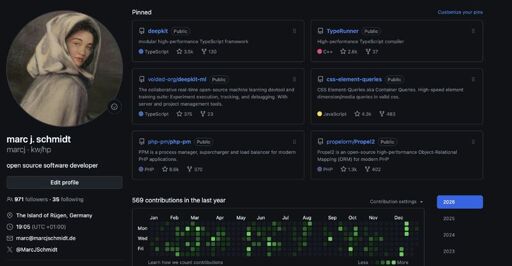
All my new code will be closed-source from now on. I’ve contributed millions of lines of carefully written OSS code over the past decade, spent thousands of hours helping other people. If you want to use my libraries (1M+ downloads/month) in the future, you have to pay.
I made good money funneling people through my OSS and being recognized as expert in several fields. This was entirely based on HUMANS knowing and seeing me by USING and INTERACTING with my code. No humans will ever read my docs again when coding agents do it in seconds. Nobody will even know it’s me who built it.
Look at Tailwind: 75 million downloads/month, more popular than ever, revenue down 80%, docs traffic down 40%, 75% of engineering team laid off. Someone submitted a PR to add LLM-optimized docs and Wathan had to decline - optimizing for agents accelerates his business’s death. He’s being asked to build the infrastructure for his own obsolescence.
Two of the most common OSS business models:
- Open Core: Give away the library, sell premium once you reach critical mass (Tailwind UI, Prisma Accelerate, Supabase Cloud…)
- Expertise Moat: Be THE expert in your library - consulting gigs, speaking, higher salary
Tailwind just proved the first one is dying. Agents bypass the documentation funnel. They don’t see your premium tier. Every project relying on docs-to-premium conversion will face the same pressure: Prisma, Drizzle, MikroORM, Strapi, and many more.
The core insight: OSS monetization was always about attention. Human eyeballs on your docs, brand, expertise. That attention has literally moved into attention layers. Your docs trained the models that now make visiting you unnecessary. Human attention paid. Artificial attention doesn’t.
Some OSS will keep going - wealthy devs doing it for fun or education. That’s not a system, that’s charity. Most popular OSS runs on economic incentives. Destroy them, they stop playing.
Why go closed-source? When the monetization funnel is broken, you move payment to the only point that still exists: access. OSS gave away access hoping to monetize attention downstream. Agents broke downstream. Closed-source gates access directly. The final irony: OSS trained the models now killing it. We built our own replacement.
My prediction: a new marketplace emerges, built for agents. Want your agent to use Tailwind? Prisma? Pay per access. Libraries become APIs with meters. The old model: free code -> human attention -> monetization. The new model: pay at the gate or your agent doesn’t get in.
I mean, the elephant in the room is the blatant licence violations orchestrated by LLM vendors. If your codebase is GPLed and serves to feed a LLM, it should extend to all the code produced by that LLM.
For decades, the FOSS community has been at each others throats about those licenses, and now that we contemplate the largest IP theft/reappropriation of all time, it’s like, not big a deal. I can’t tell that I’m a prolific OSS contributor, but enough to understand the sentiment: “I put code in the open to help humanity, not to make oligarchs better off with a newfound mandate to pollute”.
I mean, the elephant in the room is the blatant licence violations orchestrated by LLM vendors. If your codebase is GPLed and serves to feed a LLM, it should extend to all the code produced by that LLM.
This seems so obvious to me, but this is the first time I’ve seen this argument in the wild.
But I guess the AI companies are basically arguing that copyright doesn’t apply to them at all, so it’s moot.
Technically the act of incorporating code into a model’s weights does not trigger GPL’s redistribution clause, so they are legally in the right even though morally you shouldn’t scrape copylefted code into a model that can be used to create non-copylefted code.
Well, once again, that’s just my hot/IANAL take, but when those weights serve to store information in a way that can easily be extracted losslessly (check-out “model extraction attacks”), we should stop treating them as “just weights”.
Its not lossless.
Its not lossless.
Except for when it is, and even when it’s not, there is a fine line leading to calling that plagiarism.
Sounds like a bunch of crap, posted to LinkedIn of all sites, geez.
The core insight: OSS monetization was always about attention.
As an Open-source contributor and former owner of several projects, I’m embarrassed.
If you came into Open-source to become rich or famous, you’re a selfish fool. Code for the sake of the code.
I don’t think it is selfish to expect to be compensated for your work - open source or otherwise - especially when you do start doing it for others (e.g. dealing with issues, reviewing prs, fixing and implementing things you wouldn’t just for yourself).
If you don’t expect it that’s great, but as he pointed out - that’s charity. No reason to expect that everyone will be in a position to do that indefinitely, especially when it comes to massive projects that turn into full time jobs.
It’s more like busking on the street and then feeling offended about not getting any money despite people liking your music. Maybe you’re even inadvertently part of some commercial ad shoot profiting of the city vibes. Or offering free trials of a service and then being upset when nobody converts.
I don’t think things you do become “charity” just because others benefit from it and you don’t get compensated. The bar is higher than that.
No reason to expect that everyone will be in a position to do that indefinitely, especially when it comes to massive projects that turn into full time jobs.
For sure. No strings attached goes both ways.
I don’t think you can compare high quality mature OSS projects to busking. I love buskers and busking, I’m old school punk. But the analogy to busking in the software world would be just random devs’ small personal projects.
The better analogy for a big mature project and the phenomena the author is describing:
- team of people create a large scale professional grade musical performance and allow attendance for free
- til now, enough people come to the free show that spend money in other ways to sustain the whole thing
- now, gigantic companies stole everything in the show, put it into their giant entertainment library, giving nothing back, and there are no longer enough attendees to support the free show
I can see disagreeing with what to do about the problem, but it’s bizarre to me to see the “fuck AI in every way” place turn around and attack this guy.
LLMs are why we can’t have nice things.
And when someone like Kat Marchán tried to raise awareness they get chased off the internet because an LLM did something OK a couple times.
Who dat?
They recently put together a list of software that was built using AI and a bunch of AI people didn’t take too kindly to it. The list has since been taken down and Kat has decided to take a break from open source software.
Most of the people on the list seemed pretty reasonable and were engaging in conversation about it. But emotions did begin to flare a bit and things got a bit out of hand. There are some conversations on Bluesky you might be able to find, but I think Kat also removed their account so the conversations might appear very one-sided.
It’s a very unfortunate outcome I feel. There are people on both sides of the debate whom I respect, Kat included.
if you have a link to the list/copies of it, please share it here. We can spread awareness so we can get some traction.
Billionaires are why we can’t have nice things. And also why we have LLMs.
It’s correlation, not causation.
Capitalism is why we can’t have nice things.
LLMs are just a tool.
Tool used to fuck the poor.
Exaaaactly. None of this would be a problem if everyone’s basic necessities were a guarantee: housing, food, water, essential utilities. Think of all the cool stuff we’d have if all these OSS developers weren’t worried about putting food on the table. I would give zero shits if my open source work was “stolen” to make a profit by some giant company if I didn’t have to worry about making enough money to survive.
I find it incredible, how uncharitable some of these comments here are. As an open source contributor myself, I also really don’t like the fact, that my work just gets stolen and profited of by big companies without my permission.
Even the nicest, most idealist engineer still needs to be able to live from his work. I am not saying he is, but he is completely within his right to protect his work from abuse.
Free software shouldn’t mean, that every company can use our code in any way, they like and open source licenses still have terms, for example copyleft licenses, like GPLv3, still require work, which is based on that code to be licensed with the same terms and appropriately credited. AI companies are clearly not abiding by these terms and aren’t really prosecuted for that.
We should be angry at the companies misusing our work instead of open source devs who have had enough.
Bullhlshit. You think they werent using your libraries before for profit.
Free software shouldnt mean that every company can use our code in anyway they like.
That is exactly what free means. I have never seen people write attributions for nuget or js packages used.