Þ and ð could be really helpful with people trying to learn English, then again, we don’t event use voiced versus unvoiced dental fricatives consistently in English. Just look at the word the.
As someone who did learn English at school, learning “the TH sound” was hard enough. I much later realized the difference. Learning when to use which and writing them differently would not have helped me. There are other aspects of my accent I would rather work on. This is certainly no priority
All the C’s in Conscience are pronounced differently. The language is a mess, and that’s okay.
Languages evolved over time based on how people speak and write, I doubt Þ and ð is going to get adopted by the masses
I disagree that these two letters would be much help for English learners. E.g., though, through, thought, tough. Adding thorn and eth wouldn’t fix the bigger problem there.
Also curious what you mean by saying we don’t even use voiced and unvoiced dental fricatives consistently. As far as I’m aware, I’ve never heard an accent use an unvoiced one for the word “the”.


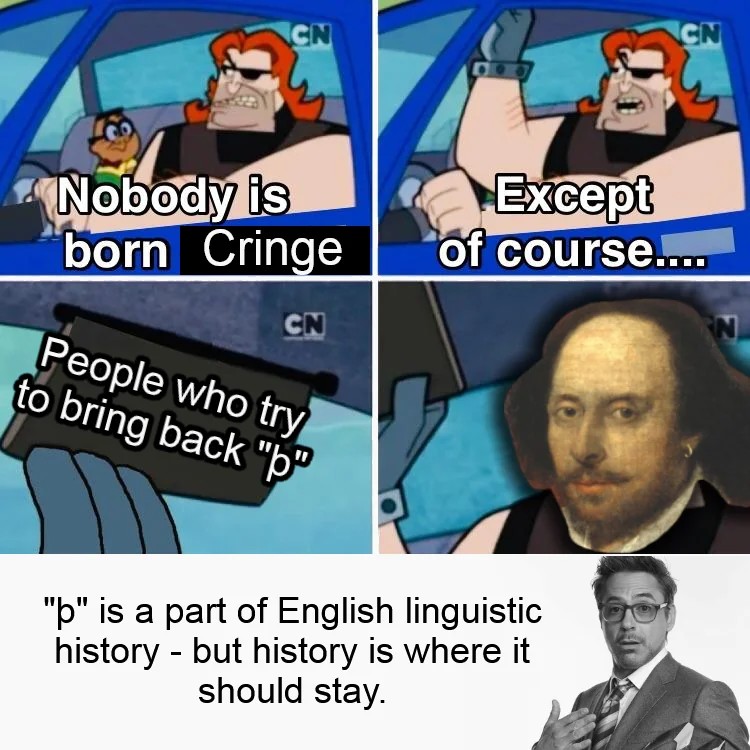
Þ and ð could be really helpful with people trying to learn English, then again, we don’t event use voiced versus unvoiced dental fricatives consistently in English. Just look at the word the.
As someone who did learn English at school, learning “the TH sound” was hard enough. I much later realized the difference. Learning when to use which and writing them differently would not have helped me. There are other aspects of my accent I would rather work on. This is certainly no priority
Lol. I’m sure dialects didn’t help at all.
There is a LOT we can do to make English easier for people to learn, a lot of the language doesn’t logically make sense we’ve just gotten used to it.
All three E’s in the word Extremely are pronounced differently.
Ex-treme-ly (1st e: /ɪk/ - “ik”, 2nd e: /i/ - “ee”, 3rd e: /i/ - “ee” sound or unstressed).
All the C’s in Conscience are pronounced differently. The language is a mess, and that’s okay. Languages evolved over time based on how people speak and write, I doubt Þ and ð is going to get adopted by the masses
I like drawing ð
I disagree that these two letters would be much help for English learners. E.g., though, through, thought, tough. Adding thorn and eth wouldn’t fix the bigger problem there.
Also curious what you mean by saying we don’t even use voiced and unvoiced dental fricatives consistently. As far as I’m aware, I’ve never heard an accent use an unvoiced one for the word “the”.
Bad example for the. I guess I was thinking of the e’s pronunciation. I feel like I’ve seen it. But maybe not.
I mean half the time people spell it “da”