I mean true but save for some weird decisions (something something bag men) that strictly goes under the war part; I can forgive the Bolsheviks for not pulling punches while fighting literal fascists, and they did address the problem as soon as they knew about it. War communism didn’t need to be as brutal or as far-reaching as it was, but for the most part it was an acceptable play in a terrible situation.
The famine in question (early '20s, not the later famine that resulted from de-kulakization) was made much worse because Lenin kept exporting food during it. The Bolsheviks did this because it was their only source of the foreign credit they needed to buy the machine tools and whatnot they needed to ramp up their industrial sector. I wouldn’t call that “war communism”, just straight “communism” as per Marx they felt industrialization was everything.
Interestingly, the only reason the death toll from this earlier famine wasn’t even larger was that Herbert Hoover (of all people) organized an international relief effort that at one point was feeding about 10% of the USSR. When the agricultural situation improved, the Bolsheviks neglected to tell Hoover.
The famine in question (early ‘20s, not the later famine that resulted from de-kulakization) was made much worse because Lenin kept exporting food during it. The Bolsheviks did this because it was their only source of the foreign credit they needed to buy the machine tools and whatnot they needed to ramp up their industrial sector.
I really think you’re mixing up the famines. Export of food to acquire industrial capital was a major motivation during the Holodomor. During the Russian Civil War, the motivation was to keep the Red Army fed and in the field without having to make concessions to the peasants, independent regions, or demobilizing any troops.
I wouldn’t call that “war communism”, just straight “communism” as per Marx they felt industrialization was everything.
War Communism is a reference to a specific set of policies adopted during the Russian Civil War.
I’m not mixing up the famines. During both famines the USSR was using agricultural products (their only significant export) to acquire industrial capital. The reason I’m talking about the first famine is that we’re talking about Lenin here, who was long dead by the second famine.
To my knowledge, grain export was not a major contributor to the first famine, especially since the Allied blockade wasn’t even lifted until the famine was already underway. Even as late as 1923 Soviet imports of food was considerable (and much of the remainder being consumer goods and raw materials, not industrial machinery) with industrialization not being emphasized until the 14th Party Congress in late 1925.

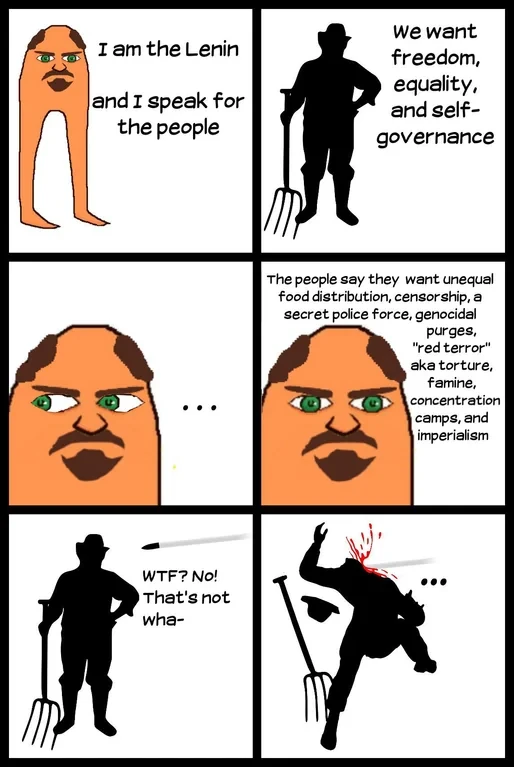
I mean, I don’t know how much blame I’d ascribe to Lenin, but his ‘war communism’ policy was very much a contributor to the famine.
I mean true but save for some weird decisions (something something bag men) that strictly goes under the war part; I can forgive the Bolsheviks for not pulling punches while fighting literal fascists, and they did address the problem as soon as they knew about it. War communism didn’t need to be as brutal or as far-reaching as it was, but for the most part it was an acceptable play in a terrible situation.
The famine in question (early '20s, not the later famine that resulted from de-kulakization) was made much worse because Lenin kept exporting food during it. The Bolsheviks did this because it was their only source of the foreign credit they needed to buy the machine tools and whatnot they needed to ramp up their industrial sector. I wouldn’t call that “war communism”, just straight “communism” as per Marx they felt industrialization was everything.
Interestingly, the only reason the death toll from this earlier famine wasn’t even larger was that Herbert Hoover (of all people) organized an international relief effort that at one point was feeding about 10% of the USSR. When the agricultural situation improved, the Bolsheviks neglected to tell Hoover.
I really think you’re mixing up the famines. Export of food to acquire industrial capital was a major motivation during the Holodomor. During the Russian Civil War, the motivation was to keep the Red Army fed and in the field without having to make concessions to the peasants, independent regions, or demobilizing any troops.
War Communism is a reference to a specific set of policies adopted during the Russian Civil War.
I’m not mixing up the famines. During both famines the USSR was using agricultural products (their only significant export) to acquire industrial capital. The reason I’m talking about the first famine is that we’re talking about Lenin here, who was long dead by the second famine.
To my knowledge, grain export was not a major contributor to the first famine, especially since the Allied blockade wasn’t even lifted until the famine was already underway. Even as late as 1923 Soviet imports of food was considerable (and much of the remainder being consumer goods and raw materials, not industrial machinery) with industrialization not being emphasized until the 14th Party Congress in late 1925.