

- cross-posted to:
- microblogmemes@lemmy.world
- cross-posted to:
- microblogmemes@lemmy.world
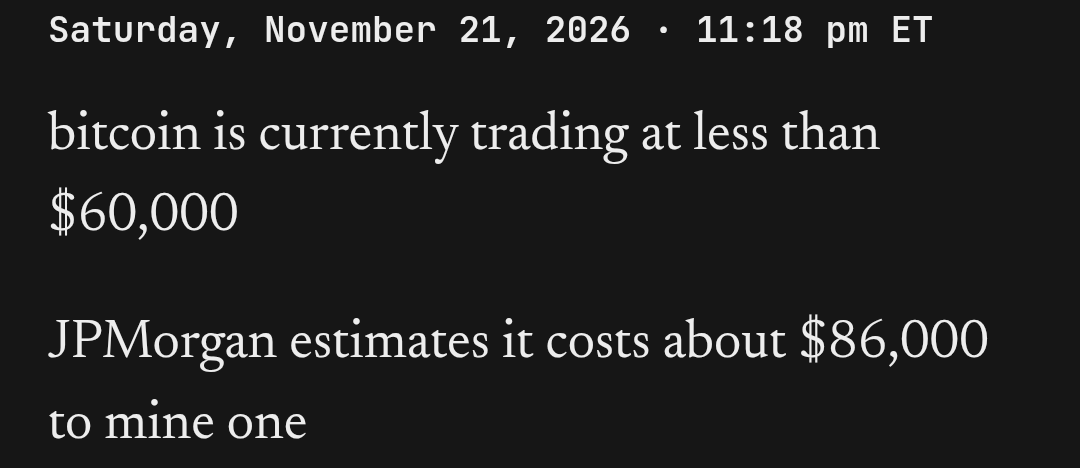
bitcoin is currently trading at less than $60,000
JPMorgan estimates it costs about $86,000 to mine one
Source: Molly White on social media.
You can describe a rule, and maybe even describe the motivation behind the rule’s design, but the behavior around the entire set of rules and incentives doesn’t always become obvious until multiple iterations of participants actually playing in the arena, so to speak. And the way the participants behave is often not predicted by the people who design the rules. You can see this in rules updates in sports, markets, regulations, etc.
The cost structures of the miners can often lead them to keep their mining operations going even when they have to operate at a loss, short term. They’ve got interest payments, might be paying rents and insurance and other fixed monthly costs, have certain obligations to buy/take a certain amount of electricity from their power purchasing agreements, etc. The difficulty can change in response to the amount of effort being expended across the network, but the participants may not have the legal or financial flexibility to perfectly jump in and out of participation in the market in a way that feeds back as you’d expect. So that feedback mechanism won’t actually behave “as designed,” in practice.
Except this is actually how it was meant to work all along. Really, this is the design. Miners are supposed to join or drop from the blockchain based on whatever economic incentives make sense to them, it’s not the blockchain’s responsibility or role to “manage” them in any other way. If a miner has come up with some kind of special deal for electricity or is accounting for depreciation in some idiosyncratic way, that’s fine - that’s on them to handle. The Bitcoin blockchain doesn’t care about that, it’s designed not to need to care about that.
All it cares about is the rate at which blocks are being found, not who’s finding them. That’s the only “feedback” mechanism built into Bitcoin. If blocks start coming in too fast the difficulty rises at the next adjustment period. If they’re coming in too slow the difficulty falls instead. The underlying reasons for those changes are simply not relevant. Could be legal issues, could be electricity market forces, could be new types of mining hardware being invented, doesn’t matter.