Gen-X here (the ones immediately after the boomers but before the Millenials), it is amazing how many of my school mates ended up having no children. Yes many did, but a surprising number did not. In my circle (childhood neighbors, classmates, family) it’s almost half.
Roughly the same amount of people want children and roughly the same amount of people have children
What has changed is when they start having children and how many they have
In the past if you had 100 women, maybe 90 of them would become mothers with 3 children
Now 85 women become parents but they only 1 or 2 children each
So yeah, fewer people are having children but not enough to really matters. The big issue is that we settle down, get married, and start families later in life, giving us less time to produce more children. So family size is shrinking.
Take every family with kids and add 2 kids, there’s your missing numbers.
It’s not that money isn’t an issue, but it’s not the driving force you would assume it is
It’s not that money isn’t an issue, but it’s not the driving force you would assume it is
Do you not think that people settling down and starting families later is related to money? In the 70s the average age for getting on the property ladder was mid 20s, now it’s mid 30s. If you don’t feel settled and financially secure you’ll delay things like starting a family.
Again, money is an issue, but it’s not THE driving force you would assume it is
For example, lifestyle plays a big part. People want to be younger longer. They want to graduate high school, go to college, party, drink, sleep around, go to concerts, etc… once they’re a little older they want to get jobs, focus on their careers, spend their days at breweries, traveling, etc…
The dream of getting married within a year of graduating high school and having your first child by the time you are 20 is long gone
This means that roughly the same amount of people are still having children, they’re just having less children because they start having children later in life. The average family size use to be 3.5 kids, now it’s 1.5 or 2.5, I can’t remember
You can see this if you go watch shows from the 50s and 60s. Shows like My Three Sons or The Brady Bunch. It was totally normal to have 3 kids; hence “middle child syndrome”
There are also less accidental pregnancies thanks to better sex education and easier access to contraceptives.
And when it comes to internet doomerism, people are claiming they’re not having kids because they’re concerned about climate change and over-population
And yes, money is also part of this list but it’s not as simple as, “can’t afford it”
Which isn’t surprising. At 22, even if you made $300k a year, you probably still wouldn’t want to stop living your life to have a kid, especially if you are a woman. At 35 or 40, sure, that money would definitely help you make the choice to have a child, or more children, but also, by 35 or 40 lots of people can already afford it
And lets be real, it’s not like poor people almost never have kids because they make great life choices… I just keep thinking about the beginning of Idiocracy. The middle class family waits until they can afford it, the trashy family in the trailer park had like 6 kids. It’s a movie, sure, but the idea is kind of the same. Money, to you, might be an issue, but it’s not to everybody.
Yes, money is a factor, but it’s not the only factor and it’s not necessarily the largest factor
People want to be younger longer. Graduate, go to college, drink, party, sleep around, get a job, focus on their career, go to concerts, hang out a breweries, travel, etc…
Tying yourself down with kids by the age of 20 or 23 is no longer a common dream. So the same amount of people have kids in life, they just star having kids later and end up with less of them.
There are less accidental pregnancies thanks to better sex education and access to contraceptives and when it comes to doomer-ism, young people are worried about climate change, over population, and like you saw from an earlier response, stupid cry-baby shit like, “I don’t want to make another wage slave”
I keep thinking about the beginning to the movie Idiocracy. Yes, it’s just a movie but the picture it paints remains somewhat valid. While money was an issue to the middle class family, the trashy poor family in the trailer park ended up with six kids.
So yeah, maybe money is an issue to you but it’s not to everyone.
And don’t get it twisted. Being poor and having kids doesn’t make you a bad person. Lots of people grow up poor to hard working, intelligent, loving parents who give them a pretty good life overall. PS5s and new cars don’t make you a good parent. A soccer ball and a tent can do wonders
Do people want to stay young longer or is it that people used to be able to afford to save for a house on an entry level wage. Now, until you’re on a decent wage it’s going to take 10 to 15 years of hard saving to get a house deposit. Faced with that unsurmountable task people say fuck it and just spend for now.
The dream is to be young and rich so you can travel and go to nightclubs and shit… not be young, rich, and a mother of 6 children
Eventually you get tired of the nightclubs and that’s when you want kids… but influencers like MrBeast, IShowSpeed, even the Kardashians didn’t rush out with their money and have kids
In 1970, the average woman in the U.S. had her first baby at around 21 years old. That’s hard to imagine now: new federal data published in April show that in 2022, the average first-time mother was a little older than 27
The foundation for this trend was laid in the 1960s, when the birth control pill came onto the scene
it has become increasingly common for people to have children later in life for a range of reasons, including concerns about finances and child care, waiting longer to get married or find a partner, and prioritizing education, career, or leisure time during young adulthood.
it’s still far more common for people to want children than to plan to stay child-free, and that most prospective parents want more than one baby. What’s different from decades past, Guzzo says, is that people are increasingly pushing back the ages at which they have those kids, often into their 30s and beyond.

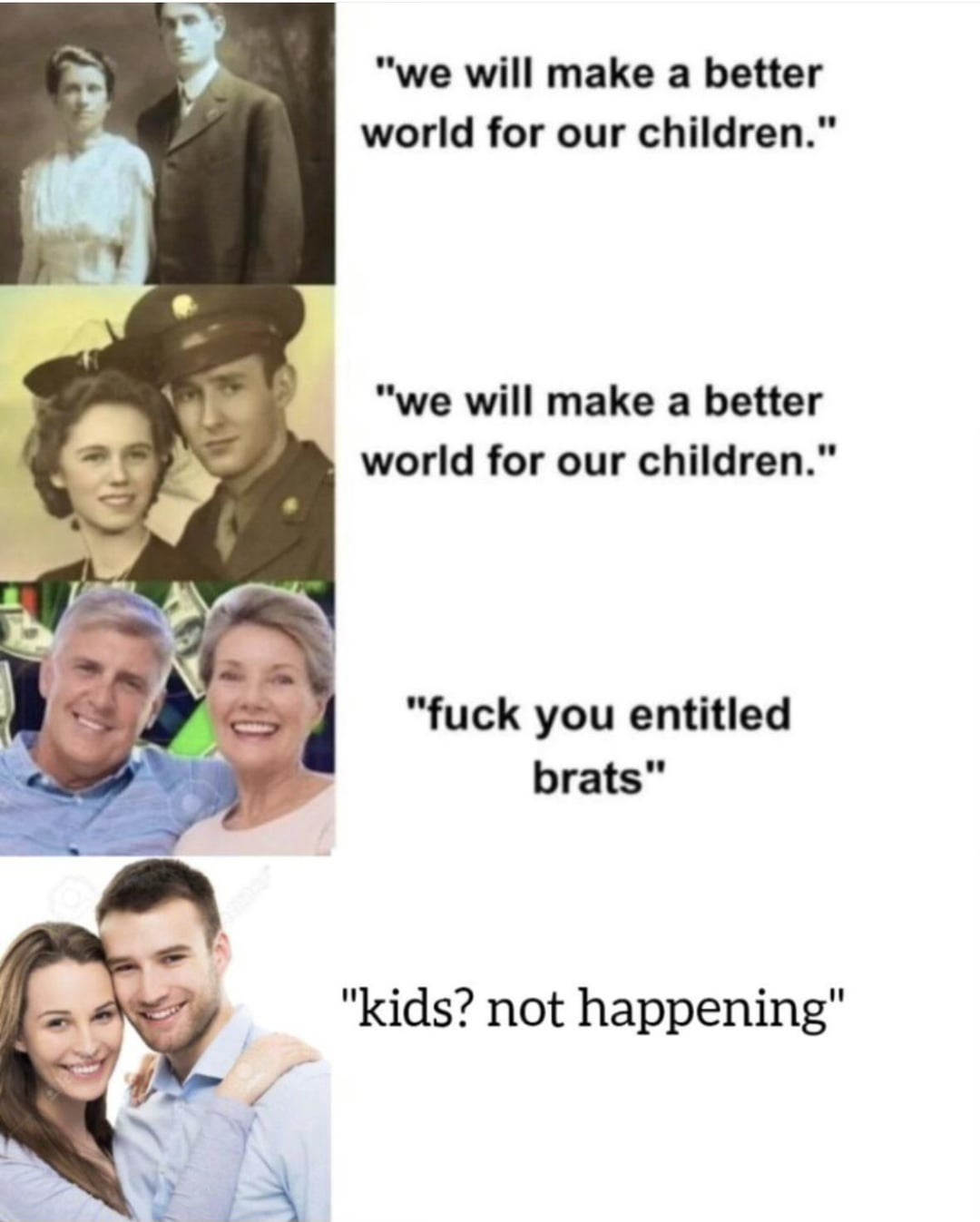
Gen-X here (the ones immediately after the boomers but before the Millenials), it is amazing how many of my school mates ended up having no children. Yes many did, but a surprising number did not. In my circle (childhood neighbors, classmates, family) it’s almost half.
Anecdotal
Roughly the same amount of people want children and roughly the same amount of people have children
What has changed is when they start having children and how many they have
In the past if you had 100 women, maybe 90 of them would become mothers with 3 children
Now 85 women become parents but they only 1 or 2 children each
So yeah, fewer people are having children but not enough to really matters. The big issue is that we settle down, get married, and start families later in life, giving us less time to produce more children. So family size is shrinking.
Take every family with kids and add 2 kids, there’s your missing numbers.
It’s not that money isn’t an issue, but it’s not the driving force you would assume it is
Do you not think that people settling down and starting families later is related to money? In the 70s the average age for getting on the property ladder was mid 20s, now it’s mid 30s. If you don’t feel settled and financially secure you’ll delay things like starting a family.
Again, money is an issue, but it’s not THE driving force you would assume it is
For example, lifestyle plays a big part. People want to be younger longer. They want to graduate high school, go to college, party, drink, sleep around, go to concerts, etc… once they’re a little older they want to get jobs, focus on their careers, spend their days at breweries, traveling, etc…
The dream of getting married within a year of graduating high school and having your first child by the time you are 20 is long gone
This means that roughly the same amount of people are still having children, they’re just having less children because they start having children later in life. The average family size use to be 3.5 kids, now it’s 1.5 or 2.5, I can’t remember
You can see this if you go watch shows from the 50s and 60s. Shows like My Three Sons or The Brady Bunch. It was totally normal to have 3 kids; hence “middle child syndrome”
There are also less accidental pregnancies thanks to better sex education and easier access to contraceptives.
And when it comes to internet doomerism, people are claiming they’re not having kids because they’re concerned about climate change and over-population
And yes, money is also part of this list but it’s not as simple as, “can’t afford it”
Which isn’t surprising. At 22, even if you made $300k a year, you probably still wouldn’t want to stop living your life to have a kid, especially if you are a woman. At 35 or 40, sure, that money would definitely help you make the choice to have a child, or more children, but also, by 35 or 40 lots of people can already afford it
And lets be real, it’s not like poor people almost never have kids because they make great life choices… I just keep thinking about the beginning of Idiocracy. The middle class family waits until they can afford it, the trashy family in the trailer park had like 6 kids. It’s a movie, sure, but the idea is kind of the same. Money, to you, might be an issue, but it’s not to everybody.
Of course it’s money related? I would love to have another child but can’t afford to. Anecdotal yes, but it’s the similar situation for others.
Yes, money is a factor, but it’s not the only factor and it’s not necessarily the largest factor
People want to be younger longer. Graduate, go to college, drink, party, sleep around, get a job, focus on their career, go to concerts, hang out a breweries, travel, etc…
Tying yourself down with kids by the age of 20 or 23 is no longer a common dream. So the same amount of people have kids in life, they just star having kids later and end up with less of them.
There are less accidental pregnancies thanks to better sex education and access to contraceptives and when it comes to doomer-ism, young people are worried about climate change, over population, and like you saw from an earlier response, stupid cry-baby shit like, “I don’t want to make another wage slave”
I keep thinking about the beginning to the movie Idiocracy. Yes, it’s just a movie but the picture it paints remains somewhat valid. While money was an issue to the middle class family, the trashy poor family in the trailer park ended up with six kids.
So yeah, maybe money is an issue to you but it’s not to everyone.
And don’t get it twisted. Being poor and having kids doesn’t make you a bad person. Lots of people grow up poor to hard working, intelligent, loving parents who give them a pretty good life overall. PS5s and new cars don’t make you a good parent. A soccer ball and a tent can do wonders
Do people want to stay young longer or is it that people used to be able to afford to save for a house on an entry level wage. Now, until you’re on a decent wage it’s going to take 10 to 15 years of hard saving to get a house deposit. Faced with that unsurmountable task people say fuck it and just spend for now.
They want to stay younger longer
The dream is to be young and rich so you can travel and go to nightclubs and shit… not be young, rich, and a mother of 6 children
Eventually you get tired of the nightclubs and that’s when you want kids… but influencers like MrBeast, IShowSpeed, even the Kardashians didn’t rush out with their money and have kids
Do you have some surveys you can point me to that backs that up?
https://time.com/6965267/women-having-kids-later/
In 1970, the average woman in the U.S. had her first baby at around 21 years old. That’s hard to imagine now: new federal data published in April show that in 2022, the average first-time mother was a little older than 27
The foundation for this trend was laid in the 1960s, when the birth control pill came onto the scene
it has become increasingly common for people to have children later in life for a range of reasons, including concerns about finances and child care, waiting longer to get married or find a partner, and prioritizing education, career, or leisure time during young adulthood.
it’s still far more common for people to want children than to plan to stay child-free, and that most prospective parents want more than one baby. What’s different from decades past, Guzzo says, is that people are increasingly pushing back the ages at which they have those kids, often into their 30s and beyond.
Money is big, but no amount of money will convince me to make a kid whose future is either wage slave or wage slave master.