Would it have been a custom piece in the 19th century though? They would have been in demand enough that it seems reasonable that they could have been hand-made in enough bulk to make them better priced than getting it made fully custom now.
it’s not like there was an economy of scale to speak of, the ones in demand were likely the equivalent of $500 today. a door knocker is still purely a luxury item.
can’t make a model like that with a solid mold. it’s too far from a convex hull. you need to sand-cast it, cut off the pouring channels, then polish up the rough surfaces. then you need to heat up the knocker part in order to bend it into shape in the mouth. even if you cast multiple heads at once that’s several days of highly skilled work per product. that doesn’t come cheap.
You can simplify this and eliminate the forging by just casting more parts and assembling them. From looking at it I thought the teeth were removable and the fastener is hidden by the beard but other similar cast knockers seem to just make the ring out of two parts. https://www.chairish.com/product/14868315/antique-satyr-face-wram-horns-iron-door-knocker
They did have an economy of scale at least to a degree. Manufacturies were lousy in much of Europe by the high medieval to late age of sail depending on region, and the Portuguese spread said manufacturing techniques as far as India.
Were peasants buying luxury door knockers? You are probably only seeing this because its good enough to have survived. The rich would have been able to pay for it but the rest of us it just doesn’t make sense to.
But today, you can get some fairly nice looking ones for under £50. Not sure if the style goes well with modern PVC doors though.
Peasants? No. Freeman and traders? Maybe. It heavily depended on region and time, but for example in my area of SoCal you see brass works of roughly similar quality from the Victorian period floating about in quantities that don’t make sense unless they were available to at least the upper lower class.
Generally, high-quality pieces would have been made by artisans (and thus usually custom), not factory-made. The high demand meant that the skills to make these pieces were more commonly pursued by woodworkers, thus making a larger labor pool (and so, cheaper labor), but the technology available and higher price of resources means that it would have required more expense in the form of materials and more man-hours to create the product.

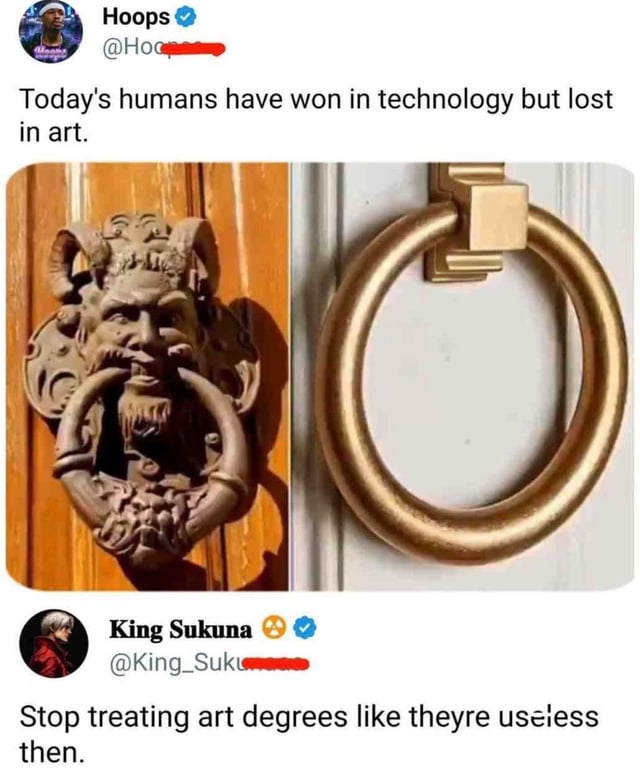
Would it have been a custom piece in the 19th century though? They would have been in demand enough that it seems reasonable that they could have been hand-made in enough bulk to make them better priced than getting it made fully custom now.
it’s not like there was an economy of scale to speak of, the ones in demand were likely the equivalent of $500 today. a door knocker is still purely a luxury item.
There kind of was
There would have been hundreds of people in the community who spent their lives doing metal working and casting
Nowadays for a vision job like that’s you’ll have to find one of a handful of specialists in your area.
Same with glass blowing and other artisanal work.
And good chance this knocker was made from a mold.
can’t make a model like that with a solid mold. it’s too far from a convex hull. you need to sand-cast it, cut off the pouring channels, then polish up the rough surfaces. then you need to heat up the knocker part in order to bend it into shape in the mouth. even if you cast multiple heads at once that’s several days of highly skilled work per product. that doesn’t come cheap.
You can simplify this and eliminate the forging by just casting more parts and assembling them. From looking at it I thought the teeth were removable and the fastener is hidden by the beard but other similar cast knockers seem to just make the ring out of two parts. https://www.chairish.com/product/14868315/antique-satyr-face-wram-horns-iron-door-knocker
what i’m taking from that link is, this is a modern knocker and the guy in the picture is an idiot :P
They did have an economy of scale at least to a degree. Manufacturies were lousy in much of Europe by the high medieval to late age of sail depending on region, and the Portuguese spread said manufacturing techniques as far as India.
Were peasants buying luxury door knockers? You are probably only seeing this because its good enough to have survived. The rich would have been able to pay for it but the rest of us it just doesn’t make sense to.
But today, you can get some fairly nice looking ones for under £50. Not sure if the style goes well with modern PVC doors though.
Peasants? No. Freeman and traders? Maybe. It heavily depended on region and time, but for example in my area of SoCal you see brass works of roughly similar quality from the Victorian period floating about in quantities that don’t make sense unless they were available to at least the upper lower class.
Would it have been a custom piece now? Granted, I didn’t find an exact match, but there are some damn similar ones on Aliexpress for like $40.
Generally, high-quality pieces would have been made by artisans (and thus usually custom), not factory-made. The high demand meant that the skills to make these pieces were more commonly pursued by woodworkers, thus making a larger labor pool (and so, cheaper labor), but the technology available and higher price of resources means that it would have required more expense in the form of materials and more man-hours to create the product.