With all due respect, this smacks of rationalizing. I’m not talking about ideology, I’m talking about outcomes.
But I’m explicitly talking about outcomes as well? I’m pointing out that the idea of ‘capitalism’, when used vaguely, often conflates the outcomes of many different systems.
“Only insofar as one is willing to subsume multiple economic systems without even marginal ideological similarities between them as a single system that bears the guilt for the actions of the polity.”
Ideological similarities here should be read not simply in terms of post-hoc justification, but in terms of the very valuations and thinking which create the processes of the systems.
You and I both know that everyone who dies or suffers from a lack of healthcare, food or shelter, just as an absolute fundamental starting point, is a victim of our system of resource distribution.
Sure, this is technically true. But the issue is that resource distribution is itself a systemic question.
It’s not as easy as “Give everyone what they need.” There’s not a simple switch to pull that would ensure reliable access to needed resources for everyone who needs them. Who decides who needs what? By what means are these needed goods produced? What motivations are used to ensure steady production? If production is short, what happens? Etc etc etc etc etc.
We have enough food and housing for everyone, but it isn’t profitable to provide it to those who need it.
And under central planning, there’s enough food and housing for everyone, but the redistributive apparatus is incapable or unwilling to provide it to all those who need it; and under feudal economic systems, there’s enough food and housing for everyone, but the redistributive apparatus is so primitive and insular that it has no interest in providing food or housing to those who need it, and we can keep going back as far as you like.
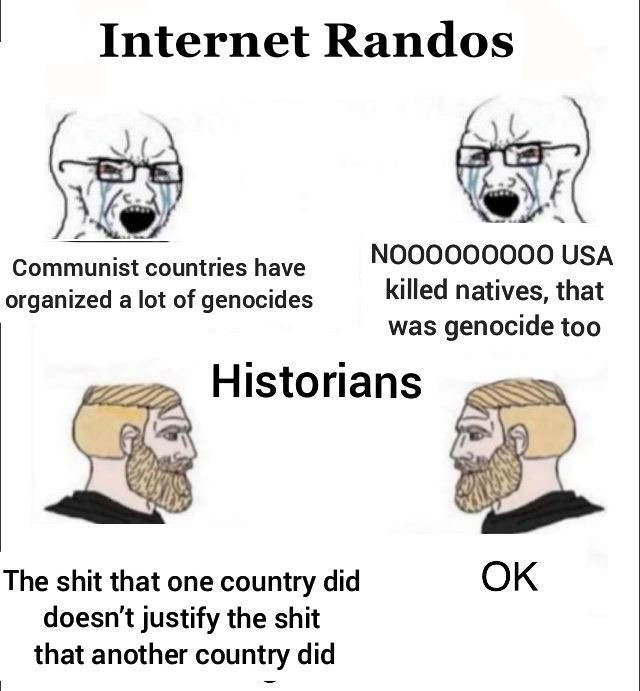
Capitalism is a shit system. But if you’re going to assign every death under well-defined capitalist systems as the fault of capitalism, then you’ll also have to assign blame likewise to other economic systems which allow death from shortages of needed goods (ie all of them so far), which would cast significant doubt into the claim that capitalism has caused more suffering and death than any other system.
It is a disgusting system and I agree with you, it has to go. And to get rid of it, we need to talk about how evil it is.
Sure, but talking about how evil it is doesn’t necessitate making dubious superlative claims. I can say Boris Johnson was a depraved shithead without needing to call him the most morally repugnant head of government to ever walk the earth, for example.
Tankies are wrong because they want the system to persist but be controlled by the working class. But the system is the problem.
… so what systems aren’t we counting as ‘capitalism’ then?
Or if it’s just “the system” rather than capitalism that’s being critiqued here, what is meant by “the system” exactly?


But I’m explicitly talking about outcomes as well? I’m pointing out that the idea of ‘capitalism’, when used vaguely, often conflates the outcomes of many different systems.
“Only insofar as one is willing to subsume multiple economic systems without even marginal ideological similarities between them as a single system that bears the guilt for the actions of the polity.”
Ideological similarities here should be read not simply in terms of post-hoc justification, but in terms of the very valuations and thinking which create the processes of the systems.
Sure, this is technically true. But the issue is that resource distribution is itself a systemic question.
It’s not as easy as “Give everyone what they need.” There’s not a simple switch to pull that would ensure reliable access to needed resources for everyone who needs them. Who decides who needs what? By what means are these needed goods produced? What motivations are used to ensure steady production? If production is short, what happens? Etc etc etc etc etc.
And under central planning, there’s enough food and housing for everyone, but the redistributive apparatus is incapable or unwilling to provide it to all those who need it; and under feudal economic systems, there’s enough food and housing for everyone, but the redistributive apparatus is so primitive and insular that it has no interest in providing food or housing to those who need it, and we can keep going back as far as you like.
Capitalism is a shit system. But if you’re going to assign every death under well-defined capitalist systems as the fault of capitalism, then you’ll also have to assign blame likewise to other economic systems which allow death from shortages of needed goods (ie all of them so far), which would cast significant doubt into the claim that capitalism has caused more suffering and death than any other system.
Sure, but talking about how evil it is doesn’t necessitate making dubious superlative claims. I can say Boris Johnson was a depraved shithead without needing to call him the most morally repugnant head of government to ever walk the earth, for example.
… so what systems aren’t we counting as ‘capitalism’ then?
Or if it’s just “the system” rather than capitalism that’s being critiqued here, what is meant by “the system” exactly?