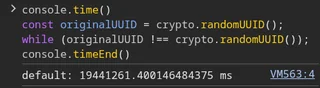

I don’t understand
console.time()jots down the current time, if you do that twice and put stuff in the middle you get two times and the difference between them is how long that stuff took to doconsole.timeEnd()uses the last execution ofconsole.time()as the starting point to work out how long the stuff took to doconst originalUUID = crypto.randomUUID()generates a Universally Unique IDentifier, which can be thought of as a very large very random number, by use of a pseudorandom number generatorwhile(stuff)evaluates the stuff for truthiness (1 + 2 = 5 would be false, 50 < 200 would be true, ‘my username starts with the letter k’ would be true) it’s typically followed by a ‘block’ of code, that is lines beginning with{and ending with}, but we don’t see that here, which means we can readwhile(stuff)as “keep checking ifstuffis true in an endless loop, and only continue to the next line if one of the checks ends up beingfalse”the
stuffhere is creating another random UUID, and checking to see if it’s the same random number as the first one generated.functions like this are so incredibly random that chancing upon two executions creating the same number should be practically impossible. staggeringly impossible. If so this code should never complete, as that
whilecheck would be endless, never finding a matchthe image suggests that one such match was found in about 19 million milliseconds (a bit over 5 hours). this is probably faked, because the absurd unlikelihood of the same number being generated in so much as a single human lifetime, let alone a day, is laughable
the image is faked or something is terribly wrong with their pseudorandom number generator