Attached: 1 image
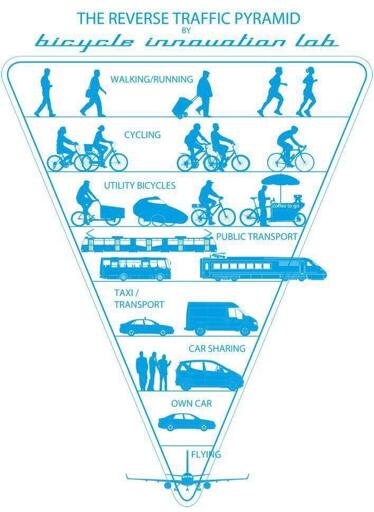
Per ridurre il traffico la piramide delle priorità deve essere rovesciata, così. In più si riducono smog, rumore, pericolo, incidenti e si migliora la salute dei cittadini e la vivibilità della città
https://benzinazero.wordpress.com/2026/02/08/la-piramide-inversa-del-traffico-urbano/ #traffico #mobilità #urbanistica #politica
За да подобрим живота в нашите градове, тези приоритети трябва да бъдат управлявани.
all high-speed trains are running on 100% renewable
Irrelevant to what I said: discounting energy source.
Trains obviously have much less rolling resistance, as you say (an advantage partly offset by their added weight). But wind resistance is the bigger factor, and trains are usually just faster.
A train travelling at 350kmh uses 40% more energy than one going at 300kmh. This is why the service speeds usually top out at 300 everywhere, Europe, japan and China.
Speed really is the decisive factor. The pyramid hints quite well at this.
But we can’t really discount the energy source. An intercity bus service running fully on renewables is not feasible neither now nor for the foreseeable future. What we should do is have more efficient rail service between city, with more slower and cheaper options for when you don’t mind the extra hour on your train.

Irrelevant to what I said: discounting energy source.
Trains obviously have much less rolling resistance, as you say (an advantage partly offset by their added weight). But wind resistance is the bigger factor, and trains are usually just faster.
A train travelling at 350kmh uses 40% more energy than one going at 300kmh. This is why the service speeds usually top out at 300 everywhere, Europe, japan and China.
Speed really is the decisive factor. The pyramid hints quite well at this.
But we can’t really discount the energy source. An intercity bus service running fully on renewables is not feasible neither now nor for the foreseeable future. What we should do is have more efficient rail service between city, with more slower and cheaper options for when you don’t mind the extra hour on your train.
Defining “green” as energy consumption is quite exotic. More commonly it has to do with resource (carbon and others) footprint.