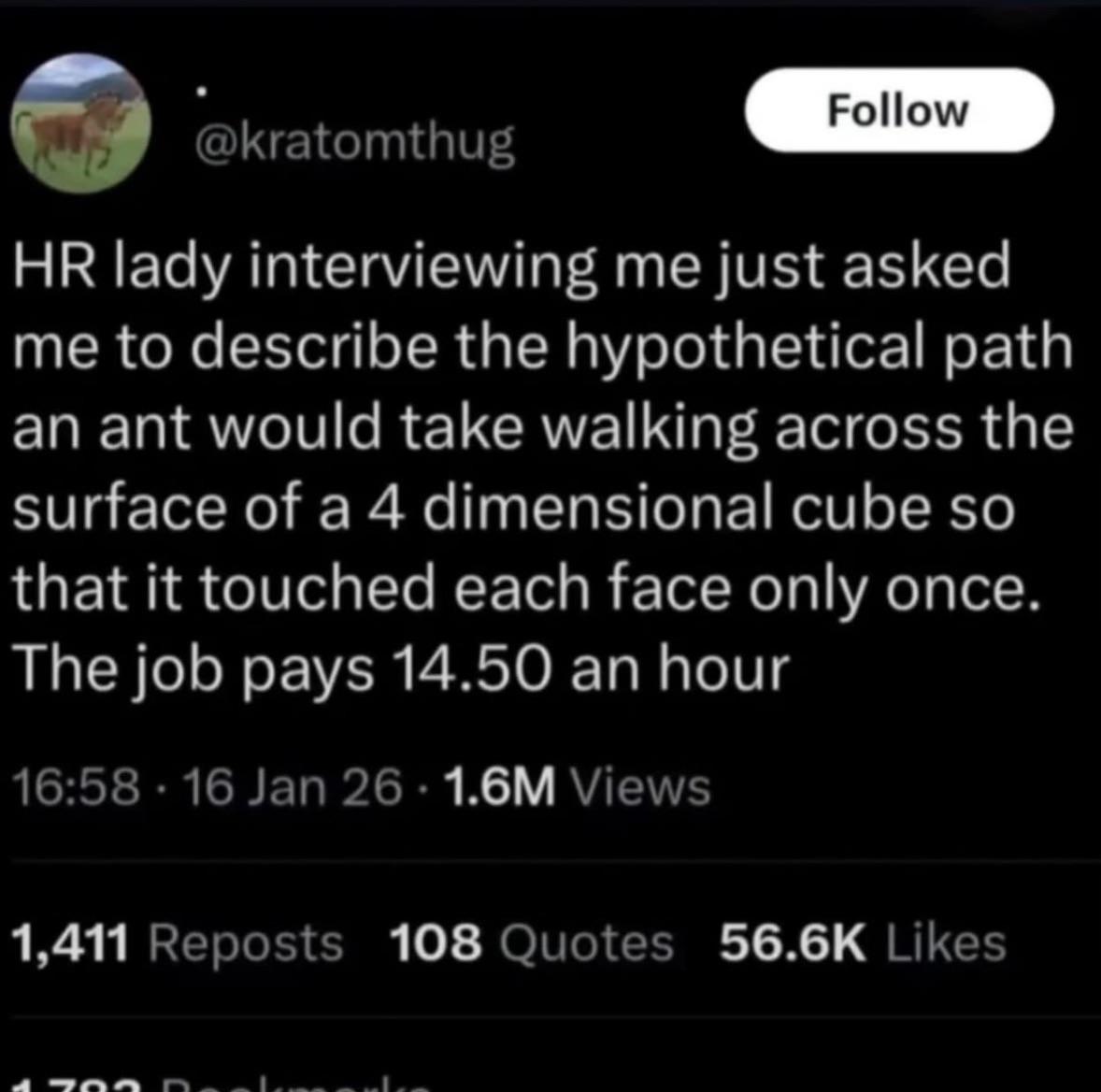
Every cube is four dimensional, assuming time as the fourth dimension. So it would travel forward in time at a relatively constant rate (since ants don’t typically walk at relativistic speeds [citation needed]) and it would traverse the other three dimensions in normal ant ways.
I was thinking 4 spatial dimensions and was trying to trace a hypercube
Damnnn bro. They gonna start you at $15 with that kinda mind.
“Being that the fourth dimension is time, it would need a flux capacitor and have to hit 88mph but where he’s going he doesn’t need ‘sides.’”
Well technically as the ant is traveling across the fourth dimension, time in most cases, in the example meaning it instantaneously travels the entire surface and touches the faces an infinite number of times in an infinite path unless only one edge touches a surface without any 3 dimensional velocity. If the latter, then let us define the faces along said edge as 1 and 4, the faces between but parallel in edges as 2 and 3, and the faces on the perpendicular axis as 5 and 6. Then, its path is 1, 5, 2, 6, 3, 4, and dismount. To ensure the ant never again approaches the cube in infinite time, have it travel in a perfect circle around the cube infinitely.
In mathematics, the 4th dimension isn’t in any way privileged, so the ant isn’t “traveling across the fourth dimension” as such, it’s tracing a path through all four dimensions, just like you’d trace a path through three dimensions.
You’re needlessly abstracting it. The ant has a constant 4th dimensional vector and a variable 1st, 2nd, and 3rd dimensional vector as a function of it.
I have traced the path, the addition of the 4th dimension doesn’t change it.
If the interviewer didn’t intend for this answer then they should have specified a different 4th dimension which is non-constant nor linear.
There’s no “constant 4th dimensional vector” here.
You’re overcomplicating it by treating the 4th dimension as time. In a tesseract puzzle, the 4th dimension is just another spatial direction. The ant simply walks across adjacent cubic cells on the hypersurface, much like walking across faces of an ordinary cube. The problem reduces to finding a path through the adjacency graph of the 8 cells.
Your lack of understanding of movement as a combination of vectors makes me think you’re talking out your ass.
This is linear algebra. The solution can be written as a matrix of 4th dimensional space. Its all vectors.
And despite your confidence, your answer is wrong. You’re talking about a 3-cube embedded in 4-space instead of a 4-cube, which is why you only see 6 faces, whereas a 4-cube (a tesseract) has 24 faces.
Four dimensional? That is a tesseract. This is impossible to describe how an ant would even interact with let alone touch all eight cells only once.
Once done with the first cube, the ant takes a gondola, going along the 4th dimension and repeats the walk he did on the first cube.
This is actually quite fun and simple! Even if the problem and my following explanation look complicated :P
Let’s look at the three dimensional case. One can parametrize a 3 dimensional cube as the Cartesian product of intervals [0, 1] x [0, 1] x [0, 1]. This means a cube is a set of points (a, b, c) where a, b and c are real numbers between 0 and 1. The 2 dimensional sides of the cube are then given by fixing one coordinate. That is, the 6 sides are
{0}    x [0, 1] x [0, 1],
{1}    x [0, 1] x [0, 1],
[0, 1] x {0}    x [0, 1],
[0, 1] x {1}    x [0, 1],
[0, 1] x [0, 1] x {0} and
[0, 1] x [0, 1] x {1}.
Now we just start in the middle of a side at (0, 0.5, 0.5). To get to the next side we walk towards an edge (0, 0, 0.5) and then to the middle of the next side (0.5, 0, 0.5). We iterate this process until we run out of sides with a fixed 0, then walk towards a side with a fixed 1 and continue there. That is:
   (0  , 0.5, 0.5)
-> (0  , 0  , 0.5)
-> (0.5, 0  , 0.5)
-> (0.5, 0  , 0  )
-> (0.5, 0.5, 0  )
-> (1  , 0.5, 0  )
-> (1  , 0.5, 0.5)
-> (1  , 1  , 0.5)
-> (0.5, 1  , 0.5)
-> (0.5, 1  , 1  )
-> (0.5, 0.5, 1  )
This path basically spirals around the cube, going through every side only once. Here’s a visualization (sorry, I’m no artist :P)

The same procedure works on a 4 dimensional cube or any other higher dimension. For the 4 dimensional cube it goes like this:
   (0  , 0.5, 0.5, 0.5)
-> (0  , 0  , 0.5, 0.5)
-> (0.5, 0  , 0.5, 0.5)
-> (0.5, 0  , 0  , 0.5)
-> ...
-> (0.5, 0.5, 0.5, 0  )
-> (1  , 0.5, 0.5, 0  )
-> (1  , 0.5, 0.5, 0.5)
-> (1  , 1  , 0.5, 0.5)
-> ...
-> (0.5, 0.5, 0.5, 1  )
This works for arbitrary dimension except for the 1 dimensional cube (which is just a line) because the “sides” there are the two end points of the line and not connected at all. Additionally note, that it is never specified how edges count in this problem, whether they somehow count towards a face or whether you’re allowed to go back and fourth on edges. You could technically only walk along edges and step into the sides every now and then.
You owe me $14.50 for reading that.
I skipped all the blabla and looked at the drawing and was pleased to see the path I started visualising in my head was exactly like that. I do think I would’ve needed a cube in my hands to confirm it, or a bit longer thinking about it instead to complete it.